By purchasing through the links, you support this site at no extra cost to you. Learn more >

Dornier Do 17, Do 217 and Do 335 Pfeil: Books - History, Construction and Deployment

A book about Dornier Do 17, Do 217 or Do 335 Pfeil combat aircraft? Explore here illustrated books on the history, construction and deployment of Dornier combat aircraft.

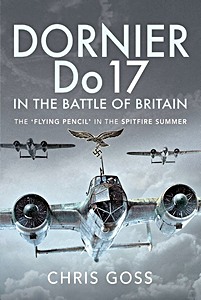
Dornier Do 17 in the Battle of Britain - The 'Flying Pencil' in the Spitfire Summer

During Britain's desperate struggle for survival that in the summer of 1940, the Dornier Do 17 played a prominent part in raids designed at neutralising the RAF's ability to resist and the British people's will to fight back.
Having been built to outrun contemporary fighters when introduced into the Luftwaffe in 1937, it had become the Luftwaffe's main light bomber, and for the attack against Britain, three bomber wings, KG 2, KG3 and KG77, were equipped with the Do 17.
But by 1940, the Do 17 was nearing obsolescence and, with its weak defensive armament, it fell prey to Fighter Command's Hurricanes and Spitfires.

Its vulnerability was starkly revealed on 18 August 1940, when eight Dorniers were shot down and nine damaged in attacks on RAF Kenley, and on 15 September - Battle of Britain Day - when twenty were shot down and a further thirteen damaged.
On that day, Sergeant Ray Holmes rammed his Hurricane into a Do 17 that was reportedly aiming for Buckingham Palace. Part of the bomber's wreckage fell to earth near Victoria Station.

In this comprehensive pictorial record of the Do 17, the bomber's role throughout the period of the Battle of Britain is displayed in the author's unique collection of British and German photographs.
These photographs, coupled with first-hand stories from those who flew and those who fought against the Do 17, bring those desperate days and dark nights back to life in the manner which only contemporary images and accounts can achieve.

Product details

Author:Chris Goss
Details:232 pages, 9.25 x 6.1 in (23.5 x 15.5 cm), hardback
Illustrations:200 b&w photos
Language:English
Publisher:Pen & Sword Books Ltd (GB, 2021)
ISBN:9781526781208
Book cover: Dornier Do 17 in the Battle of Britain - The 'Flying Pencil' in the Spitfire Summer | Pen & Sword

Dornier Do 17 in the Battle of Britain - The 'Flying Pencil' in the Spitfire Summer

Language: English

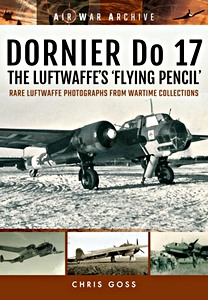
Dornier Do 17 the Luftwaffe's 'Flying Pencil' : Rare Luftwaffe Photographs from Wartime Collections (Air War Archive)

For the first three years of the Second World War, the Dornier Do 17 was the Luftwaffe's principal light bomber. Designed to be fast enough to outrun contemporary fighter aircraft, the Dornier helped to spearhead Germany's Blitzkrieg as Hitler's armies raced through Poland and then France and the Low Countries.

Until its withdrawal to secondary duties in 1941, the Dornier Do 17 served in every theatre of war involving German forces. This included the invasion of the Balkans and Greece as well as the battle to capture Crete. After suffering heavy losses at the hands of Fighter Command in the Battle of Britain, the Do 17 was employed in Operation Barbarossa, the invasion of the Soviet Union in 1941.

The Do 17 was withdrawn from frontline service later in 1941 but continued to be used by the German Air Force in various roles until the end of the war, including seeing service as a glider tug and in the defence of the Reich in 1944 as a night fighter.

In this compilation of unrivalled images collected over many years, and now part of Frontline's new War in the Air series, the widespread deployment of the Dornier Do 17 is portrayed and brought to life.

Product details

Author:Chris Goss
Details:128 pages, 9.7 x 7.5 in (24.5 x 19 cm), paperback
Illustrations:200 b&w photos
Language:English
Publisher:Frontline Books (GB, 2016)
ISBN:9781848324718
Book cover: Dornier Do 17 the Luftwaffe's 'Flying Pencil' : Rare Luftwaffe Photographs from Wartime Collections | Frontline

Dornier Do 17 the Luftwaffe's 'Flying Pencil' : Rare Luftwaffe Photographs from Wartime Collections

Language: English

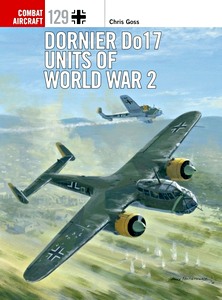
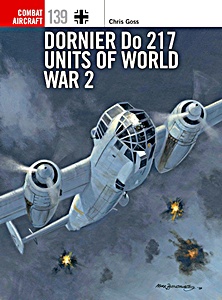
Dornier Do 17 Units of World War 2 (Osprey)

Initially designed as a high-speed mail aeroplane and airliner, the Do 17 first made an appearance as a military aircraft in the Spanish Civil War, both as a bomber and in reconnaissance roles.
In the early stages of World War II, it, together with the Heinkel He 111, formed the backbone of the German bomber arm over Poland, France, Belgium and the Low Countries, and saw action in almost every major campaign in this period.

However, by the start of the Battle of Britain, the Do 17's limited range and small bomb load meant that it was ripe for replacement by the Ju 88. Though it performed well at lower altitudes, the model suffered heavy losses during raids, particularly during the Blitz and were increasingly phased out.

This fully illustrated study uses detailed full-colour artwork and authoritative text from an expert author to tell the full operation story of one of Nazi Germany's best light bombers from the early years of World War II.

Product details

Author:Chris Goss
Details:96 pages, 9.7 x 7.3 x 0.31 in (24.5 x 18.5 x 0.8 cm), paperback
Illustrations:70 b&w and color photos
Language:English
Publisher:Osprey Publishing (GB, 2019)
Series:Combat Aircraft (129)
ISBN:9781472829634
Book cover: Dornier Do 17 Units of World War 2 | Combat Aircraft (129) | Osprey

Dornier Do 17 Units of World War 2

Language: English

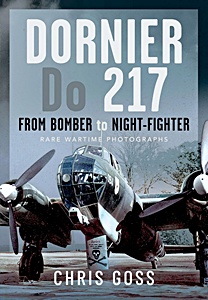
Dornier Do 217 - From Bomber to Night-Fighter: Rare Wartime Photographs

NEW

This book presents the development and service history of the Dornier Do 217, introduced in early 1941 as an improved version of the Do 17 bomber. The first Do 217E-1 flew in October 1940, shortly after Do 17 production ended.
The aircraft was first used for bombing and anti-shipping missions around the United Kingdom, including the Baedeker attacks in 1942. It remained Germany's main bomber in this area until late 1943, when newer types such as the Me 410 and Ju 188 replaced it. Improved versions, the Do 217K and M, followed, mainly differing in their engines.

The Do 217 served in all Luftwaffe campaigns, though on the Eastern Front it was used mostly for night reconnaissance. It became the first aircraft to use precision-guided weapons in combat, when KG 100 units attacked Allied ships in Sicily in July 1943 with Fritz X bombs, followed by further attacks with Hs 293 weapons in August 1943.

To counter growing Allied night raids, a night-fighter version, the Do 217J-1, was created with extra forward-firing guns and radar. Later aircraft also carried upward-firing cannon. Although versatile and widely deployed, production ended in October 1943, and the type became obsolete soon after.

Product details

Author:Chris Goss
Details:288 pages, 9.8 x 6.9 x 1.1 in (25 x 17.5 x 2.8 cm), hardback
Illustrations:300 b&w photos
Language:English
Publisher:Air World (GB, 2025)
ISBN:9781473883093
Book cover: Dornier Do 217 - From Bomber to Night-Fighter: Rare Wartime Photographs | Air World

Dornier Do 217 - From Bomber to Night-Fighter: Rare Wartime Photographs

Language: English

Dornier Do 217 1941-1945: A Combat and Photographic Record in Luftwaffe Service 1941-1945

The Dornier Do 217 represented the refinement of German twin-engined bomber design, a progression from the earlier Do 17. From 1941, the Do 217 became the mainstay of the Luftwaffe's bomber arm in the West, equipping four Gruppen for operations over Britain.
It carried out day and night attacks on British shipping, coastal targets, towns and industrial centres, both in formation and in lone attacks known to the German crews as 'Pirate' operations. These missions, though achieving some success, were undertaken at considerable cost to the crews of the Do 217s, a measure of the strength of opposition it encountered in the RAF's nightfighter squadrons, improved radar and anti-aircraft defences.

As the demand from Germany's battlefronts grew from early 1942, the Do 217, albeit in very limited numbers, was developed into a radar-equipped nightfighter. In the Mediterranean it was used as an effective maritime strike aircraft, launching highly developed stand-off bombs and remotely-controlled glide-bomb weapons in the form of the 'Fritz X' and Hs 293 which accounted for the destruction or damage of several notable warships.
It was also used as a night reconnaissance aircraft on the Eastern Front and over Britain in the Luftwaffe's 1942 'Baedeker Blitz'.

Following extensive research, including interviews and correspondence with former aircrew and their families, renowned Luftwaffe historian, Chris Goss, has documented the operational history of the Do 217 and offers the most comprehensive account so far published in the English language.
The story is complemented by hundreds of rare photographs, many never before published, as well specially commissioned colour artwork.

Product details

Author:Chris Goss
Details:184 pages, 12 x 9.1 x 0.79 in (30.5 x 23 x 2 cm), hardback
Illustrations:250+ b&w photos
Language:English
Publisher:Crecy Publishing (GB, 2022)
ISBN:9781906537586
Book cover: Dornier Do 217 1941-1945: A Combat and Photographic Record in Luftwaffe Service 1941-1945 | Crecy

Dornier Do 217 1941-1945: A Combat and Photographic Record in Luftwaffe Service 1941-1945

Language: English

Dornier Do 217 Units of World War 2 (Osprey)

The Do 217 had a much larger bomb load capacity and had considerably greater range than the Do 17, which it replaced in frontline service from mid to late 1941. Although initially used simply as a bomber, later variants were developed to allow the Do 217 to undertake the precision maritime strike role.
In order to perform the latter mission, the Do 217 was modified to launch glide bombs - units employing these pioneering weapons enjoyed some success in the Mediterranean from the autumn of 1943.

During the course of these operations the Do 217 became the first aircraft in military aviation history to deploy a precision-guided bomb in combat in the form of the 'Fritz X' radio-guided, free-fall weapon, which sank the Italian battleship Roma shortly after Italy capitulated in September 1943.
The Do 217 served on all fronts, and was often used on anti-shipping strikes during the Battle of the Atlantic and against the Allied invasion fleet at Normandy. This versatile aircraft was also converted into a nightfighter, seeing action in the Defense of the Reich through to war's end.

This highly illustrated study explores the design and development of the Do 217 and chronicles its use in the frontline as a strategic bomber, launch platform for first generation precision weapons, reconnaissance aircraft and nightfighter, among others.

Product details

Author:Chris Goss
Details:96 pages, 9.8 x 7.3 x 0.31 in (25 x 18.5 x 0.8 cm), paperback
Illustrations:b&w photos, drawings in color
Language:English
Publisher:Osprey Publishing (GB, 2021)
Series:Combat Aircraft (139)
ISBN:9781472846174
Book cover: Dornier Do 217 Units of World War 2 | Combat Aircraft (139) | Osprey

Dornier Do 217 Units of World War 2

Language: English

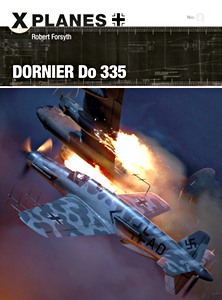
Dornier Do 335 (Osprey)

The Dornier Do 335 was conceived as a high-speed, all-weather fighter, and represented the pinnacle of piston-engined aircraft design. The Do 335 was a big aircraft, weighing just over 10,000kg when laden with fuel, equipment, and pilot, yet powered by two Daimler-Benz DB 603 engines, it was capable of reaching a maximum speed of 750km/h at 6400 meters, making it the fastest piston engine aircraft produced in Germany during World War II.

Some forty aircraft were built between late 1943 and the end of the war, and it was intended to deploy the type as a day fighter, bomber, night fighter, bad weather interceptor, and reconnaissance aircraft, all of which were intended to incorporate the latest armament, bomb sights, communications, and radar equipment, as well as an ejector seat.

Featuring archive photography and specially commissioned artwork, this is the full story of the aircraft that the Luftwaffe hoped would turn the tide of the war.

Product details

Author:Robert Forsyth
Details:80 pages, 9.7 x 7.3 x 0.31 in (24.5 x 18.5 x 0.8 cm), paperback
Illustrations:many b&w and color photos
Language:English
Publisher:Osprey Publishing (GB, 2018)
Series:X-Planes (9)
ISBN:9781472828897
Book cover: Dornier Do 335 | X-Planes (9) | Osprey

Dornier Do 335

Language: English

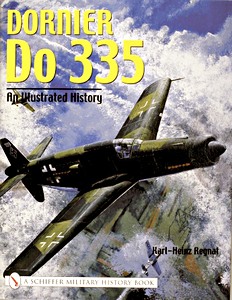
Dornier Do 335 : An Illustrated History

The Do 335 was developed by Dornier as a heavy fighter in 1943. One of the last high-performance piston-engined aircraft designed, the Do 335 was powered by tandem fore-aft engines, a concept proven in numerous Dornier flying boats. As a result of this configuration, drag was reduced to little more than that of a single-engined aircraft, enabling the Do 335 to achieve very high speeds.
The Do 335 represented the apex of propeller-driven aircraft in the Second World War.

This is the first comprehensive, well-illustrated documentation on the Do 335, one of the milestones in German aviation history.

Product details

Author:Karl-Heinz Regnat
Details:216 pages, 11.2 x 8.9 x 0.87 in (28.5 x 22.5 x 2.2 cm), hardback
Illustrations:240+ b&w and color photos
Language:English
Publisher:Schiffer Publishing Ltd (USA, 2004)
ISBN:9780764318726
Book cover: Dornier Do 335 : An Illustrated History | Schiffer

Dornier Do 335 : An Illustrated History

Language: English

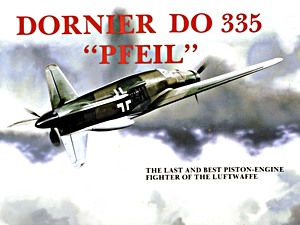
Dornier Do 335 'Pfeil' - The Last and Best Piston-engine Fighter of the Luftwaffe

A book dedicated to the Dornier Do 335 Pfeil. This late WWII aircraft was the fastest piston engine fighter of the war.

Product details

Author:Heinz J. Nowarra
Details:48 pages, 8.1 x 9.7 x 0.12 in (20.5 x 24.5 x 0.3 cm), paperback
Illustrations:over 80 b&w photos, drawings
Language:English
Publisher:Schiffer Publishing Ltd (USA, 2004)
ISBN:9780887401893
Book cover: Dornier Do 335 'Pfeil' - The Last and Best Piston-engine Fighter of the Luftwaffe | Schiffer

Dornier Do 335 'Pfeil' - The Last and Best Piston-engine Fighter of the Luftwaffe

Language: English

More titles on Dornier:

Book cover: Dornier Do X - The Story of Claude Dornier's Legendary Flying Boat

Dornier Do X - The Story of Claude Dornier's Legendary Flying Boat

Volker A. Behr | English | hardback | 232 p. | 2013

Book cover: Dassault / Dornier Alpha Jet: Flying with air forces around the world | Aircraft in Detail (18)

Dassault / Dornier Alpha Jet: Flying with air forces around the world

Robert Pied, Nicolas Deboeck | English | paperback | 116 p. | 2021

Book cover: Dornier Do 23 - First Bomber of the Wehrmacht

Dornier Do 23 - First Bomber of the Wehrmacht

Hans Peter Dabrowski | English | paperback | 48 p. | 2004

Book cover: Dornier Do 24 Units | Combat Aircraft (110)

Dornier Do 24 Units

Peter de Jong | English | paperback | 96 p. | 2015

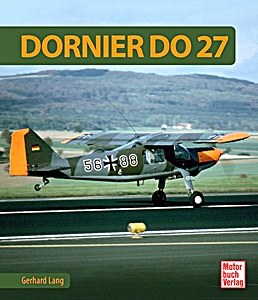
Book cover: Dornier Do 27 | Flugzeugtypen

Dornier Do 27

Gerhard Lang | German | hardback | 224 p. | 2021

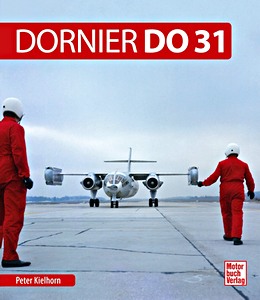
Book cover: Dornier Do 31 | Flugzeugtypen

Dornier Do 31

Peter Kielhorn | German | hardback | 240 p. | 2018

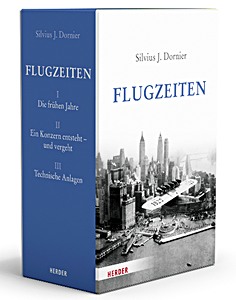
Book cover: Flugzeiten: Aus dem Leben und Werk meines Vaters, Claude Dornier

Flugzeiten: Aus dem Leben und Werk meines Vaters, Claude Dornier

Silvius Dornier | German | hardback | 1240 p. | 2015

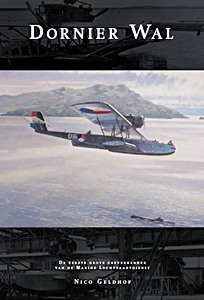
Book cover: Dornier Wal - de eerste grote zeeverkenner van de Marine Luchtvaartdienst

Dornier Wal - de eerste grote zeeverkenner van de Marine Luchtvaartdienst

Nico Geldhof | Dutch | hardback | 352 p. | 2014