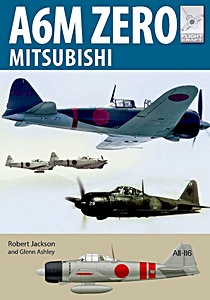
Mitsubishi A6M Zero (Flight Craft)
The Mitsubishi A6M Zero first flew on 1 April 1939 and soon proved superior to early Allied fighters in the Pacific. Light, strong and highly manoeuvrable, it carried two 20 mm cannon and two 7.7 mm machine guns.
Its structure was unusual for the time: the engine, cockpit, forward fuselage and wings formed a single rigid section, joined to the rear fuselage and tail by 80 bolts.
In 1942 the Americans gave the A6M the code name Zeke, but the name Zero became widely used. During the first months of the Pacific War, the aircraft achieved notable results. In the battle for Java, ending on 8 March 1942, Zero pilots destroyed about 550 Allied aircraft.
As the war continued, the Zero was increasingly outperformed by newer American fighters such as the F6F Wildcat and the Corsair. In the final phase of the war, many Zeros were fitted with bombs for Kamikaze attacks.
This book offers a clear overview of the Zero's design and operational history. It explains why the aircraft was created, how it behaved in combat, how it compared with its opponents, and who designed and flew it. Technical data, photos and colour profiles complete the volume.
Product details
| Author: | Robert Jackson |
|---|---|
| Details: | 96 pages, 12 x 8.5 x 0.24 in (30.5 x 21.5 x 0.6 cm), paperback |
| Illustrations: | 200 b&w and color photos |
| Language: | English |
| Publisher: | Pen & Sword Books Ltd (GB, 2021) |
| Series: | Flight Craft (22) |
| ISBN: | 9781526759948 |