Acquistando tramite i link, sostieni nostro sito senza alcun costo aggiuntivo per te. Per saperne di più >

Programma Skylab della NASA (1973-1979): libri illustrati di storia e guide

Esplora i migliori libri illustrati sulla stazione spaziale Skylab. Scopri la storia dello Skylab, dal suo lancio nel 1973 al suo rientro nell'atmosfera nel 1979.

Programma Skylab della NASA (1973-1979): libri illustrati di storia e guide | Selezione rapida

Skylab a Guidebook

Skylab's launch in 1973 represented a major milestone in America's space program. Intended to enrich scientific knowledge of the Earth, Sun and space, America's first space station was also intended to prove that humans could live and work in zero gravity for extended periods. The station's design originated from a 1959 proposal by Wehrner von Braun to use an empty rocket stage as an orbiting laboratory - Skylab's Orbital Workshop design was built around a Saturn S-IVB stage.
With a total length of about 117 feet and a mass of 169.950 pounds, the station was about the size of an average house. It included a multi-spectral solar observatory, two docking ports, and Airlock Module with EVA hatches, and a large habitation area. Power on-board came from solar arrays and the fuel cells of the docked Apollo CSM.

Skylab was damaged by vibrations during lift-off, destroying an important meteoroid shield and one of the station's two solar panel arrays. The second array could not be deployed until the crew of the SL-2 mission made an EVA to fix it. The crew remained in space for 28 days, a record eclipsed by the next two missions SL-3 (59 days) and SL-4 (84 days). After the SL-4 crew returned to the Earth in 1974 plans were made to refurbish Skylab, but delays with the Space Shuttle program proved fatal, and the station re-entered Earth's atmosphere and disintegrated in 1979.

Dating from just prior to the station's deployment in 1973, this informative book was originally published by NASA to explain Skylab's mission to the public. Featuring chapters detailing the station's history, design, components, operation, and research projects, it presents an important overview of the Skylab program.

Dettagli del libro

Autore:Leland F Belew, Ernst Stuhlinger
Formato:178 pagine, 21 x 13.5 x 1 cm, brossura
Illustrazioni:riccamente illustrato con foto e disegni
Lingua:inglese
Editore:Periscope Film (USA, 2012)
ISBN:9781937684884
Copertina del libro: Skylab a Guidebook | Periscope

Skylab a Guidebook

Lingua: inglese

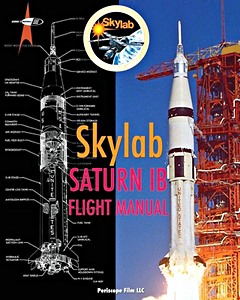
Skylab Saturn IB - Flight Manual

Created as an aid for the astronauts training for Skylab missions, this Skylab Saturn IB Flight Manual is a comprehensive reference that contains descriptions of ground support interfaces, prelaunch operations, and emergency procedures. It also summarizes mission variables and constraints, mission control monitoring and data flow during launch and flight.
Launch vehicle SL-2 (SA-206; first Skylab manned mission) was used as the baseline for the manual, but the material is also representative of the SL-3 and SL-4 launch vehicles. Also known as the "Uprated Saturn I", Saturn IB was first launched in 1966. The IB replaced the Saturn I's S-IV second stage with the more powerful S-IVB, allowing it to carry a partially fueled Apollo Command / Service Module or fully fueled Lunar Module into low Earth orbit.
The Saturn IB allowed critical testing of the Apollo Program's systems to be conducted long before the Saturn V was ready. It also flew one orbital mission without a payload, with the extra fuel used to demonstrate that the S-IVB's J-2 engine could be restarted in zero gravity - a critical operation for translunar injection.
The Saturn IB had a height of 141.6 feet and a mass of 1.3 million pounds without payload. It produced thrust equivalent to 1.6 million pounds force, and could carry 46,000 pounds of payload to low Earth orbit. Saturn IB flew nine times, including three Skylab missions and for the Apollo-Soyuz Test Project.

Complete with many informative diagrams and photos, this manual is a wonderful reference for who ever wondered how these mighty rockets were designed and built.

Dettagli del libro

Autore:NASA
Formato:282 pagine, 25.5 x 20.5 x 1.5 cm, brossura
Illustrazioni:riccamente illustrato con foto e disegni
Lingua:inglese
Editore:Periscope Film (USA, 2013)
ISBN:9781937684204
Copertina del libro: Skylab Saturn IB - Flight Manual | Periscope

Skylab Saturn IB - Flight Manual

Lingua: inglese

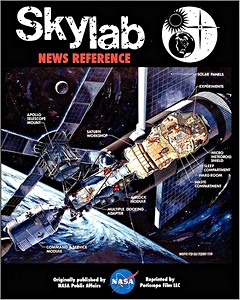
NASA Skylab - News Reference

America's first space station, known as Skylab, proved the concept of a zero-g laboratory and orbiting observatory, and paved the way for today's International Space Station. Launched on May 14, 1973, the station nearly didn't make it into operation when an aluminum micro-meteoroid shield tore loose during lift-off, taking one of two solar power arrays with it. While Skylab made orbit, the station was left underpowered and its interior overheated.
NASA quickly came up with a salvage plan and after a ten-day delay the crew of the SL-2 mission rendezvoused with the station. Contingency repairs, including the installation of a parasol-like sun shield and deployment of the remaining solar array, succeeded and Skylab functioned more or less as intended for the duration of its mission.
During that time two additional crews designated SL-3 and SL-4 visited the station and conducted a wide range of experiments. The SL-4 crew departed the station on February 8, 1974 after spending 83 days in orbit. During that time they performed four EVAs, shot 75,000 images of the sun, filmed Comet Kohoutek and traveled over 34.5 million miles.
Despite this terrific success, Skylab would never be occupied again. The end of the Saturn V era and delays with the Space Shuttle program resulted in the station's abandonment, and it burned up in the Earth's atmosphere in 1979.

Originally created by NASA in 1973 to inform the press corps about America's first space station, this Skylab News Reference contains chapters detailing the station's hardware and systems. It also provides detailed information concerning flight operations, launch facilities, experiments on board, crew training, contractors and project management. Also included are official press releases for the SL-1 and SL-2, SL-3 and SL-4 missions.

Dettagli del libro

Autore:NASA
Formato:500 pagine, 25.5 x 20.5 x 2.6 cm, brossura
Illustrazioni:riccamente illustrato con foto e disegni
Lingua:inglese
Editore:Periscope Film (USA, 2012)
ISBN:9781937684846
Copertina del libro: NASA Skylab - News Reference | Periscope

NASA Skylab - News Reference

Lingua: inglese

Titoli correlati:

Copertina del libro: NASA Space Shuttle - Transportation System Manual

NASA Space Shuttle - Transportation System Manual

NASA, Rockwell International | inglese | brossura | 624 p. | 2011

Copertina del libro: To Orbit and Back Again : How the Space Shuttle Flew in Space

To Orbit and Back Again : How the Space Shuttle Flew in Space

Davide Sivolella | inglese | brossura | 524 p. | 2013

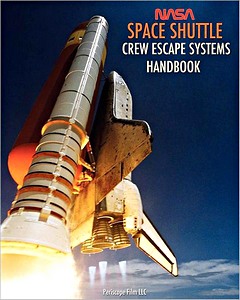
Copertina del libro: NASA Space Shuttle - Crew Escape Systems Handbook

NASA Space Shuttle - Crew Escape Systems Handbook

United Space Alliance | inglese | brossura | 168 p. | 2012

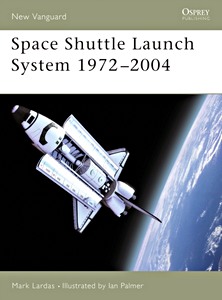
Copertina del libro: Space Shuttle Launch System 1972–2004 | New Vanguard (99)

Space Shuttle Launch System 1972–2004

Mark Lardas | inglese | brossura | 48 p. | 2004

Copertina del libro: The Space Shuttle Program : Technologies and Accomplishments

The Space Shuttle Program : Technologies and Accomplishments

Davide Sivolella | inglese | brossura | 360 p. | 2017

Anni coperti: 1973 1974 1975 1976 1977 1978 1979