En achetant via ces liens, vous soutenez notre site sans frais supplémentaires pour vous. En savoir plus >

Destroyers - Grande Bretagne : livres - histoire et navires

Un livre sur les destroyers de la Royal Navy ? Découvrez ici des beaux livres sur l'histoire et types des destroyers de Grande-Bretagne.

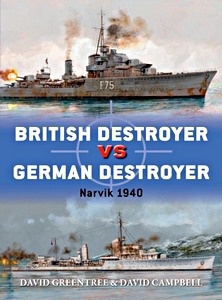
British Destroyer vs German Destroyer : Narvik 1940 (Osprey)

The opening months of World War II saw Britain's Royal Navy facing a resurgent German navy, the Kriegsmarine. Following the German invasion of Denmark and Norway in early April 1940, British and German destroyers would clash in a series of battles for control of the Norwegian coast.
The operational environment was especially challenging, with destroyer crews having to contend with variable weather, narrow coastal tracts and possibility of fog and ship breakdowns.

In two engagements at Narvik, the Royal Navy entered the harbour and attacked the loitering German destroyers who had dropped off mountain troops to support the German invasion. The raids were devastating, halving at a stroke the number at Hitler's disposal.

Employing specially commissioned artwork and drawing upon a range of sources, this absorbing study traces the evolving technology and tactics employed by the British and German destroyer forces, and assesses the impact of the Narvik clashes on both sides' subsequent development and deployment of destroyers in a range of roles across the world's oceans.

Caractéristiques

Auteur :David Greentree
Présentation :80 pages, 25 x 18.5 cm, broché
Illustration :abondamment illustré de photos en N&B et en couleurs
Langue :anglais
Editeur :Osprey Publishing (GB, 2018)
Série :Duel (88)
ISBN :9781472828583
Couverture du livre : British Destroyer vs German Destroyer : Narvik 1940 | Duel (88) | Osprey

British Destroyer vs German Destroyer : Narvik 1940

Langue : anglais

British Destroyers - From Earliest Days to the Second World War

In the late 19th century the advent of the modern torpedo woke the Royal Navy to a potent threat to its domination, not seriously challenged since Trafalgar. For the first time a relatively cheap weapon had the potential to sink the largest, and costliest exponents of sea power. Not surprisingly, Britain's traditional rivals invested heavily in the new technology that promised to overthrow the naval status quo.

The Royal Navy was also quick to adopt the new weapon, but the British concentrated on developing counters to the essentially offensive tactics associated with torpedo-carrying small craft. From these efforts came 'torpedo catchers', torpedo-gunboats and eventually the torpedo-boat destroyer, a type so successful that it eclipsed and the usurped the torpedo-boat itself. With its title shortened to 'destroyer', the type evolved rapidly and was soon in service in many navies, but in none was the evolution as rapid or as radical as in the Royal Navy

This book is the first detailed study of their early days, combining technical history with an appreciation of the changing role of destroyers and the tactics of their deployment. Like all of Friedman's books, it reveals the rationale and not just the process of important technological developments.

Caractéristiques

Auteur :Norman Friedman
Présentation :320 pages, 29.5 x 25.5 x 2.6 cm, relié
Illustration :300 illustrations en N&B
Langue :anglais
Editeur :Seaforth Publishing (GB, 2009)
ISBN :9781848320499
Couverture du livre : British Destroyers - From Earliest Days to the Second World War | Seaforth

British Destroyers - From Earliest Days to the Second World War

Langue : anglais

British Destroyers - J-C and Battle Classes (Ship Craft)

The 'ShipCraft' series provides in-depth information about building and modifying model kits of famous warship types. Lavishly illustrated, each book takes the modeller through a brief history of the subject class, highlighting differences between sisterships and changes in their appearance over their careers. This includes paint schemes and camouflage, featuring colour profiles and highly-detailed line drawings and scale plans.
The modelling section reviews the strengths and weaknesses of available kits, lists commercial accessory sets for super-detailing of the ships, and provides hints on modifying and improving the basic kit. This is followed by an extensive photographic survey of selected high-quality models in a variety of scales, and the book concludes with a section on research references - books, monographs, large-scale plans and relevant websites.

A follow-up to ShipCraft 11 on inter-war destroyers, this new volume deals with the later classes which were the most modern British destroyers of the Second World War. Marked by a common single-funnelled silhoutte, they were actually very varied, ranging from the large and powerful J to N flotillas, via the austere 'War Emergency' classes that were built in large numbers, to the radically different 'Battle' class, designed with a powerful AA armament for service in the Pacific.

Caractéristiques

Auteur :Les Brown
Présentation :64 pages, 29.5 x 21 x 0.7 cm, broché
Illustration :130 photos et dessins
Langue :anglais
Editeur :Seaforth Publishing (GB, 2013)
Série :ShipCraft (21)
ISBN :9781848321809
Couverture du livre : British Destroyers - J-C and Battle Classes | ShipCraft (21) | Seaforth

British Destroyers - J-C and Battle Classes

Langue : anglais

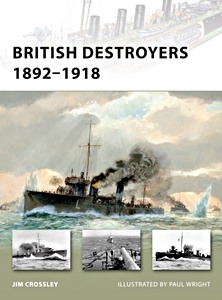
British Destroyers 1892-1918 (Osprey)

Presents the history of the first destroyers of the Royal Navy, which revolutionized the way war was fought at sea with new armaments and a great improvement on earlier designs. Moreover, between 1892, when the first destroyers were laid down, and 1918, destroyers evolved radically from 27-knot, 250-ton ships into 35-knot, 1,530-ton ships.

All these ships were involved in some form during World War I; the smaller, original destroyers in an auxiliary support role and the newer, larger destroyers at some of the greatest sea battles of the war.

This account highlights the role the destroyers played in the North Sea during the crucial battles to control the Heliogoland Bight, as well as the major fleet action at the battle of Jutland in 1916.
Complete with a detailed description of the technical evolution of each class of destroyer from the 27-knotters to the Tribal and Marksman classes, Jim Crossley offers a complete overview of the vessels that helped to maintain Britain's naval supremacy.

Caractéristiques

Auteur :Jim Crossley
Présentation :48 pages, 25 x 18.5 x 0.5 cm, broché
Illustration :abondamment illustré de photos et dessins (en N&B et en couleurs)
Langue :anglais
Editeur :Osprey Publishing (GB, 2009)
Série :New Vanguard (163)
ISBN :9781846035142
Couverture du livre : British Destroyers 1892-1918 | New Vanguard (163) | Osprey

British Destroyers 1892-1918

Langue : anglais

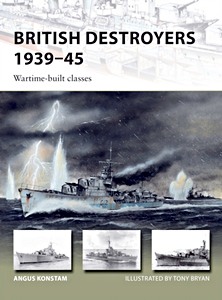
British Destroyers 1939-45 - Wartime-built classes (Osprey)

As the possibility of war loomed in the 1930s, the British Admiralty looked to update their fleet of destroyers to compete with the new ships being built by Germany and Japan, resulting in the commissioning of the powerful Tribal-class.
These were followed by the designing of the first of several slightly smaller ships, which carried fewer guns than the Tribals, but were armed with a greatly enlarged suite of torpedoes.
The first of these, the 'J/K/M class' was followed by a number of wartime variants, with slight changes to their weaponry to suit different wartime roles.
Designed to combat enemy surface warships, aircraft and U-boats, the British built these destroyers to face off against anything the enemy could throw at them.

Using a collection of contemporary photographs and beautiful colour artwork, this is a fascinating new study of the ships that formed the backbone of the Royal Navy during World War II.

Caractéristiques

Auteur :Angus Konstam
Présentation :48 pages, 25 x 18.5 x 0.5 cm, broché
Illustration :abondamment illustré de photos en N&B et en couleurs
Langue :anglais
Editeur :Osprey Publishing (GB, 2017)
Série :New Vanguard (253)
ISBN :9781472825803
Couverture du livre : British Destroyers 1939-45 - Wartime-built classes | New Vanguard (253) | Osprey

British Destroyers 1939-45 - Wartime-built classes

Langue : anglais

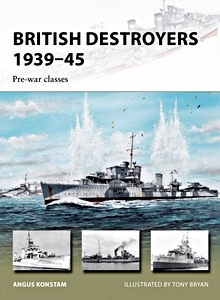
British Destroyers 1939-45 : Pre-war classes (Osprey)

The Royal Navy entered World War II with a large but eclectic fleet of destroyers. Some of these were veterans of World War I, fit only for escort duties. Most though, had been built during the inter-war period, and were regarded as both reliable and versatile.

Danger though lurked across the seas as new destroyers being built in Germany, Italy and Japan were larger and better armoured. So, until the new, larger Tribal-class destroyers could enter service, these vessels would have to hold the line. Used mainly to hunt submarines, protect convoys from aerial attack, and take out other destroyers, these ships served across the globe during the war.

This fully illustrated study is the first in a two-part series on the real workhorses of the wartime Royal Navy, focusing on how these ageing ships took on the formidable navies of the Axis powers.

Caractéristiques

Auteur :Angus Konstam
Présentation :48 pages, 25 x 18.5 x 0.8 cm, broché
Illustration :30 photos en N&B et 10 en couleurs
Langue :anglais
Editeur :Osprey Publishing (GB, 2017)
Série :New Vanguard (246)
ISBN :9781472816368
Couverture du livre : British Destroyers 1939-45 : Pre-war classes | New Vanguard (246) | Osprey

British Destroyers 1939-45 : Pre-war classes

Langue : anglais

British Destroyers and Frigates : The Second World War and After

Since the Second World War the old categories of British destroyer and frigate have tended to merge, a process that this book traces back to the radically different Tribal class destroyers of 1936.
It deals with the development of all the modern destroyer classes that fought the war, looks at the emergency programmes that produced vast numbers of trade protection vessels - sloops, corvettes and frigates - then analyses the pressures that shaped the post-war fleet, and continued to dominate design down to recent years.

Written by America's leading authority, it is an objective but sympathetic view of the difficult economic and political environment in which British designers had to work, and benefits from the author's ability to compare and contrast the US Navy's experience.

Norman Friedman is renowned for his ability to explain the policy and strategy changes that drive design decisions, and his latest book uses previously unpublished material to draw a new and convincing picture of British naval policy over the previous seventy years and more. Hugely successful with enthusiasts and professionals alike from its first publication in 2006, this paperback is the book's third printing.

Caractéristiques

Auteur :Norman Friedman
Présentation :352 pages, 29 x 24.5 cm, broché
Illustration :200+ photos en N&B, vues de profil
Langue :anglais
Editeur :Pen & Sword Books Ltd (GB, 2017)
ISBN :9781526702821
Couverture du livre : British Destroyers and Frigates : The Second World War and After | Pen & Sword

British Destroyers and Frigates : The Second World War and After

Langue : anglais

British Guided Missile Destroyers : County-Class, Type 82, Type 42 and Type 45 (Osprey)

In the years after World War II, new guided missile technology offered surface ships the chance to destroy airborne threats from afar, thereby preserving their role in naval warfare.

This book examines the technology and combat performance of Britain's guided missile destroyers over half a century. Uniquely among modern destroyers, three of these classes have been tested in battle against the aircraft and missiles of another modern navy - in the Falklands War - as well as being deployed during the Gulf War.

Written by an expert on British naval technology, this book assess the changing technology of the Royal Navy's destroyers over half a century, including an examination of the Royal Navy's newest and most capable warship, the Type 45.

Contents: Introduction: the maritime air threat and the defensive missile - The County-class destroyers - The Type 82 destroyer: HMS Bristol - The Type 42: Sheffield-class destroyers - The Type 45: Daring-class destroyers - Operational Service - Conclusion - Bibliography - Index.

Caractéristiques

Auteur :Edward Hampshire, Paul Wright
Présentation :48 pages, 25 x 18.5 x 0.5 cm, broché
Illustration :20 photos en N&B et 27 en couleurs
Langue :anglais
Editeur :Osprey Publishing (GB, 2016)
Série :New Vanguard (234)
ISBN :9781472811165
Couverture du livre : British Guided Missile Destroyers : County-Class, Type 82, Type 42 and Type 45 | New Vanguard (234) | Osprey

British Guided Missile Destroyers : County-Class, Type 82, Type 42 and Type 45

Langue : anglais

HMS Bristol: In a class of her own

The Type 82 Destroyer HMS Bristol was born in a blaze of glory as lead ship in a proposed class of four - designed to escort a new generation of super carriers for the Royal Navy. The carriers never materialised and neither did the other Type 82s, leaving Bristol literally in a class of her own.
Completed as a trials ship for new equipment, she was at one point the best-armed and best-equipped vessel in the fleet.

This book covers the ship's political background and eventual acceptance into service, her various roles and equipment trials, her deployments - including during the Falklands War in the South Atlantic, where she was flagship for a time - her withdrawal from the operational fleet, her second life as an accommodation and training ship and her decommissioning in 2020.

Author Rob Griffin presents the story of HMS Bristol complete with a wealth of rare photos and tales from those who served on board.

Caractéristiques

Auteur :Rob Griffin
Présentation :144 pages, 25.5 x 19 x 0.6 cm, relié
Illustration :abondamment illustré
Langue :anglais
Editeur :Mortons Media Group (GB, 2022)
ISBN :9781911658757
Couverture du livre : HMS Bristol: In a class of her own | Mortons

HMS Bristol: In a class of her own

Langue : anglais

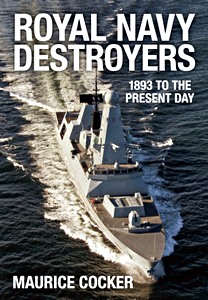
Royal Navy Destroyers - 1893 to the Present Day

In 1870 the British Admiralty commended to Parliament the weapon known as the 'Hydrostatic Torpedo', a weapon of surprise and stealth that required a small, speedy craft to launch it, especially in the early days when its range was only half a nautical mile, and thus came to be built HMS Lightning, the first torpedo boat for the Royal Navy.

The potential for the weapon was soon realised and the Admiralty was obliged to find a new design to accommodate it. In 1873 the 'torpedo boat destroyer' was born.
The TBD became indispensable to the navies of the world and in two world wars its importance both as an offensive and defensive weapon for fleet and convoy escort duties showed that no task at sea was too much for the destroyer.
The post-war Royal Navy has seen cutbacks and increased sophistication.

The destroyer - now larger and armed with guided missiles - has seen both, and in this revised and updated second edition Maurice Cocker charts its history, providing much new information and a comprehensive record of the history and appearance of each class. An invaluable reference book for all maritime historians.

Caractéristiques

Auteur :Maurice Cocker
Présentation :160 pages, 24.5 x 17.5 x 1.2 cm, broché
Illustration :illustré
Langue :anglais
Editeur :The History Press Ltd (GB, 2011)
ISBN :9780752461595
Couverture du livre : Royal Navy Destroyers - 1893 to the Present Day | The History Press

Royal Navy Destroyers - 1893 to the Present Day

Langue : anglais

Royal Navy Torpedo Vessels 1870 - 1914

The self-propelled or locomotive torpedo was probably the greatest game-changer in the history of naval warfare. For the first time the largest warship could be sunk by a weapon carried by the smallest, and most navies were quick to see the potential.
Although the 19th-century Royal Navy had a reputation for technological conservatism, it was an 'early adopter' of the torpedo and was instrumental in the development of the small fast craft that became the delivery system of choice, the steam torpedo boat.
Britain's most important contribution to torpedo warfare, however, was the invention of its antidote, the torpedo boat destroyer, or 'destroyer' as it came to be called. This often-told story has overshadowed the earlier but no less significant history of the torpedo boat itself in the Royal Navy, an injustice set to right by this book.

Torpedoes were derived from earlier underwater explosive devices - mines, spar and towed torpedoes, and the like - so the first chapter briefly reviews their history before moving on to Robert Whitehead's revolutionary invention that made the self-propelled torpedo a practical weapon.
The Admiralty was so impressed it purchased the rights to Whitehead's device, and thereafter the Royal Navy made much of the early running in torpedo boat design. In this they were greatly assisted by existing boatbuilders like Thornycroft and Yarrow who already specialised in small fast craft.

The core of this book is a detailed developmental history of British torpedo craft, from the early experiments like Vesuvius and Polyphemus, through the 1st Class TBs to the so-called Coastal Destroyers of the early 20th century. There are also separate chapters on 2nd Class boats, on Torpedo Gunboats and on the 'Torpedo Depot Ships' Hecla and Vulcan.
The book concludes with a number of appendices devoted to background issues like quick-firing guns and reports on performance of the boats in various circumstances.
As it fills a surprising gap in the technical history of British warships, this book will be welcomed by naval enthusiasts, modelmakers and historians.

Caractéristiques

Auteur :Les Brown
Présentation :192 pages, 26.5 x 22 x 2.3 cm, relié
Illustration :200 photos en N&B, 8 pages en couleurs
Langue :anglais
Editeur :Seaforth Publishing (GB, 2023)
ISBN :9781399022859
Couverture du livre : Royal Navy Torpedo Vessels 1870 - 1914 | Seaforth

Royal Navy Torpedo Vessels 1870 - 1914

Langue : anglais

Town Class Destroyers - A Critical Assessment

Early in World War II, fifty obsolete US Navy destroyers were transferred to the Royal Navy in return for a 99-year lease British bases in the Caribbean, Bahamas and Newfoundland. Though they were obsolete and far from ideal, they played a vital role in the Royal Navy's campaign. This is their complete story.

Topics covered include the background to the acquisition of the ships - the Battle of the Atlantic; their specification and design, and modifications in RN service; operations and achievements, such as the St Nazaire Raid and finally, losses and accidents. This authoritative text is supported by many contemporary photographs and twenty eight detailed plans prepared specially for this book.

Caractéristiques

Auteur :John Henshaw
Présentation :96 pages, 22 x 30.5 x 1.6 cm, relié
Illustration :50 photos en N&B, 28 vues de profil
Langue :anglais
Editeur :The Crowood Press Ltd (GB, 2018)
ISBN :9781785004018
Couverture du livre : Town Class Destroyers - A Critical Assessment | Crowood

Town Class Destroyers - A Critical Assessment

Langue : anglais

Autres livres dans cette catégorie :

Couverture du livre : British Motor Torpedo Boat 1939-45 | New Vanguard (74)

British Motor Torpedo Boat 1939-45

Angus Konstam | anglais | broché | 48 p. | 2003

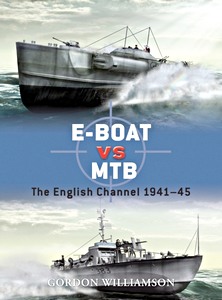
Couverture du livre : E-boat vs MTB - The English Channel 1941-45 | Duel (34)

E-boat vs MTB - The English Channel 1941-45

Gordon Williamson | anglais | broché | 80 p. | 2011

Couverture du livre : British Motor Gun Boat 1939-45 | New Vanguard (166)

British Motor Gun Boat 1939-45

Angus Konstam | anglais | broché | 48 p. | 2010

Couverture du livre : Dog Boats at War - Royal Navy D Class MTBs and MGBs 1939-1945

Dog Boats at War - Royal Navy D Class MTBs and MGBs 1939-1945

Leonard C. Reynolds | anglais | broché | 304 p. | 2009