By purchasing through the links, you support this site at no extra cost to you. Learn more >

Tanks - Germany: Illustrated History Books & Guides

Explore the best illustrated books on German tanks. Discover the history, models and evolution of tanks from Germany.

Axis Tanks of the Second World War - Rare photographs from wartime archives (Images of War)

The German Army used tanks to devastating effect in their Blitzkrieg campaigns during the early years of the Second World War and in the intense defensive battles leading up to final defeat in 1945.

It may be a surprise to many that the Japanese Army had more tanks than Nazi Germany in 1938; these included the Type 95 light tank and the Type 89 and 97 medium tanks. Co-belligerents in the Axis Alliance that built their own tanks included Italy, Romania and Hungary.
The latter was responsible for the Toldi and Turan light tank series.

As can be seen from the descriptions and images in this classic Images of War series work, the Axis powers had drawn on British and, in some cases, French design for their tanks in the period leading up to the Second World War: the Carden-Loyd tankette suspension was used in the Panzer 1 series and the light Italian and Japanese tanks.
German engineering talent resulted in the original and ingenious designs of the Panzer II, III and IV series and, later in the War, the Panther Medium and Tiger heavy tanks.

This latest work by author and expert Mike Green will fascinate and inform historians, engineers and war gamers.

Product details

Author:Michael Green
Details:208 pages, 9.7 x 7.5 in (24.5 x 19 cm), paperback
Illustrations:250 b&w and color photos
Language:English
Publisher:Pen & Sword Books Ltd (GB, 2017)
Series:Images of War
ISBN:9781473887008
Book cover: Axis Tanks of the Second World War - Rare photographs from wartime archives | Images of War | Pen & Sword

Axis Tanks of the Second World War - Rare photographs from wartime archives

Language: English

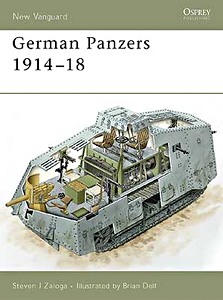
German Panzers 1914-18 (Osprey)

Panzer warfare is synonymous with the Wehrmacht of World War II.

This book examines the story of the Panzer's more mysterious ancestors, the little-known panzers of the Great War. Germany was very slow to develop armored vehicles compared to Britain and France. Efforts to catch-up proved difficult, and only a few dozen German A7V tanks were completed in time to take part in the final campaigns of 1918. As a result, the majority of German panzer units actually used captured British tanks, the Beutepanzer.
This book traces the development of German panzers of the World War One, including the A7V and its intended but unfinished stablemates.

Contents: Introduction - Early Roots - The Early Tank Program - The Cambrai Shock - A7V Variants ·Panzers in Training - Into Combat - Rebuilding the Tank Units - German Armored Cars in Combat - Final Tank Battles - Plan 1919 - Further Reading - Color Plate Commentary - Index.

Product details

Author:Steven J. Zaloga
Details:48 pages, 9.7 x 7.3 x 0.2 in (24.5 x 18.5 x 0.5 cm), paperback
Illustrations:photos and drawings (in b&w and color)
Language:English
Publisher:Osprey Publishing (GB, 2006)
Series:New Vanguard (127)
ISBN:9781841769455
Book cover: German Panzers 1914-18 | New Vanguard (127) | Osprey

German Panzers 1914-18

Language: English

Mark IV vs A7V - Villers-Bretonneux 1918 (Osprey)

The German A7V and the British Mark IV were similar in weight, size, and speed, but differed significantly in armour, armament and maneuverability. The A7V had thicker armour, and had nearly double the horsepower per ton. The Mark IV's pair of side-mounted 6pdr cannons forced the vehicle to present its side arc to an enemy in order to fire one of its main guns. Possessing twice as many machine guns as the Mark IV, the A7V had a frontally mounted 57mm gun that proved capable of defeating the Mark IV's armour. The Mark IV's rhomboid design proved superior in crossing trenches, climbing obstacles and moving over rough terrain.
As the first tank-versus-tank engagement in history, the fighting around Villers-Bretonneux showcased the British Mark IV and German A7V designs. Although not purpose-built to combat enemy armour, both vehicles proved the viability of such operations, which during the postwar period led to key advances in suspension, armour, gunsights, ammunition, and command and control. While the British continued to develop their armoured forces, German armour development never materialized, and only in the postwar period did they address the issue.

This book describes the A7V and the Mark IV in detail.

Contents: Introduction - Chronology - Design and Development - Technical Specifications - The Combatants - The Strategic Situation - Combat - Statistics and Analysis - Further Reading - Index.

Product details

Author:David R. Higgins, Ian Palmer
Details:80 pages, 9.7 x 7.3 x 0.24 in (24.5 x 18.5 x 0.6 cm), paperback
Illustrations:photos and drawings (in b&w and color)
Language:English
Publisher:Osprey Publishing (GB, 2013)
Series:Duel (49)
ISBN:9781780960050
Book cover: Mark IV vs A7V - Villers-Bretonneux 1918 | Duel (49) | Osprey

Mark IV vs A7V - Villers-Bretonneux 1918

Language: English

Panzers of the Wehrmacht 1933-1945 (Fact File)

A valuable reference on vehicles of the German Wehrmacht. During the Second World War the tank became the main weapon of every army. This Fact File edition provides a concise technical history of German WW2 tanks.

Product details

Author:Alexander Lüdeke
Details:128 pages, 8.1 x 5.5 in (20.5 x 14 cm), paperback
Illustrations:75 b&w and 94 color photos
Language:English
Publisher:Pen & Sword Books Ltd (GB, 2015)
Series:Fact File
ISBN:9781473823976
Book cover: Panzers of the Wehrmacht 1933-1945 | Fact File | Pen & Sword

Panzers of the Wehrmacht 1933-1945

Language: English

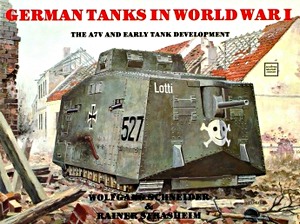
The German Tanks in WW I - The A7V and Early Tank Development

This book covers the earliest forms of German armored fighting vehicles used primarily in WW I, including the A7V tank.

Product details

Author:Werner Haupt
Details:48 pages, 4.9 x 11 x 0.12 in (12.5 x 28 x 0.3 cm), paperback
Illustrations:b&w photos, drawings
Language:English
Publisher:Schiffer Publishing Ltd (USA, 2004)
ISBN:9780887402371
Book cover: The German Tanks in WW I - The A7V and Early Tank Development | Schiffer

The German Tanks in WW I - The A7V and Early Tank Development

Language: English

The Kaiser's Panzers - German Tanks of The First World War (Images of War)

NEW

This book traces the development of German armoured vehicles during the First World War. The Imperial German Army was slow to adopt tanks in a conflict dominated by trench warfare and, by the Armistice of November 1918, had deployed only twenty A7V tanks.
To make up for this shortfall, captured British Mark IV tanks were repaired and put into service at a workshop in Belgium during the last year of the war. Some of these vehicles were later used by the Freikorps to suppress uprisings in Berlin and Leipzig.

Although German tanks had little impact on the war, two early commanders gained later prominence: Ernest Volckheim, an interwar armour theorist and later Panzer officer, and Josef "Sepp" Dietrich, SS general involved in the 1945 Malmedy massacre.

Drawing on contemporary records, newsreels, and press reports, "The Kaiser's Panzers- provides a richly illustrated account of Germany's first tanks, the foundation of the Panzer forces that emerged under the Third Reich.

Product details

Author:David Mitchelhill-Green
Details:272 pages, 9.7 x 1.2 x 6.77 in (24.5 x 3 x 17.2 cm), paperback
Illustrations:200 b&w photos
Language:English
Publisher:Pen & Sword Books Ltd (GB, 2025)
Series:Images of War
ISBN:9781805001799
Book cover: The Kaiser's Panzers - German Tanks of The First World War | Images of War | Pen & Sword

The Kaiser's Panzers - German Tanks of The First World War

Language: English

Le char allemand A7V

The A7V was the only German tank of the First World War, which can be explained by General Ludendorff's lack of interest in armored vehicles. It was only built in about twenty examples, which did not prevent its use in all the major battles of 1918, starting with Operation Michael on March 21. Its small number prevented it from playing a real tactical role on the ground.

This 32-page booklet, illustrated with excellent period photographs and color illustrations by Éric Schwartz, is part of a series of monographs published by Ysec Éditions on the weapons and vehicles of the Great War.

Product details

Author:Yves Buffetaut
Details:32 pages, 9 x 6.3 x 0.12 in (24 x 16 x 0.3 cm), paperback
Illustrations:many b&w and color photos
Language:French
Publisher:Ysec Editions (F, 2018)
ISBN:9782846733014
Book cover: Le char allemand A7V | Ysec

Le char allemand A7V

Language: French

Les panzers allemands de la Seconde Guerre mondiale

It is through the emblematic figure of the tank, and more specifically the German tank - the Panzer - that this book tells the story of the Second World War. Panzer is a word of Germanic origin meaning "armored" or "shell".
While the term is now applied to all German armored vehicles, from their origins to the present day, usage has it that it essentially refers to the tracked armored vehicles with turrets of the German army of the Second World War (Panzerkampfwagen "armored combat car", often abbreviated to PzKpfw). The latter have a particular design and tactical use that made the difference on many fronts.

Indeed, after the Great War, neither Great Britain nor the United States paid as much attention to the question of improving armored vehicles as the German Wehrmacht. The Allied powers therefore fell significantly behind in this area of research.
In 1944, German tanks such as the Panther or the Tiger were technically superior to Allied tanks such as the Sherman.

Through 300 iconographic documents including many period color photographs and very precise technical drawings, all the German panzers of the conflict are described, illustrated and contextualized, including the prototypes never used on the ground. The more recent developments of German tanks are also mentioned in the book.
Finally, a part of the book is devoted to the presentation of the collections of the main museums in the world which host tanks and participated in the development of this book.

Product details

Details:176 pages, 11.8 x 9.25 x 0.75 in (30 x 23.5 x 1.9 cm), hardback
Illustrations:many b&w and color photos
Language:French
Publisher:Glénat (F, 2020)
ISBN:9782344044957
Book cover: Les panzers allemands de la Seconde Guerre mondiale | Glénat

Les panzers allemands de la Seconde Guerre mondiale

Language: French

Deutsche Panzertechnik - Motoren und Getriebe 1925-1945

Nations experimented early on with different engine types and designs in tank construction. Germany initially lagged behind, but began adapting Maybach engines originally designed for trucks and luxury cars before the official start of rearmament. The question of maneuverability was crucial, and until now little detail was available on all of these factors.

Pages of the book Deutsche Panzertechnik-Motoren und Getriebe 1925-1945 (1)

Pages of the book "Deutsche Panzertechnik - Motoren und Getriebe 1925-1945"

Michael Fröhlich now presents the development of German tank engines, gearshifts and steering gears in a well-founded reference work. The volume contains numerous previously unseen illustrations, technical drawings and sketches.

Product details

Author:Michael Fröhlich, Frank Köhler
Details:288 pages, 10.8 x 9 x 0.91 in (27.5 x 24 x 2.3 cm), hardback
Illustrations:563 b&w and color photos
Language:German
Publisher:Motorbuch Verlag (D, 2022)
ISBN:9783613045118
Book cover: Deutsche Panzertechnik - Motoren und Getriebe 1925-1945 | Motorbuch

Deutsche Panzertechnik - Motoren und Getriebe 1925-1945

Language: German

Deutsche Panzertechnik: Prototypen und Kleinserien 1920-1945

This reference work presents for the first time in detail the drive technology of the German armored fighting vehicles produced between 1920 and 1945 in small series or as prototypes, as well as special designs.
The focus is on the design, production and further development, including the internal structure and function of the engines, gearshift and steering gears used in these vehicles.

The book is completed with interior photographs of museum exhibits and a presentation of the attachments commonly used at the time.

Product details

Author:Michael Fröhlich, Frank Köhler
Details:320 pages, 10.6 x 9.25 x 0.94 in (27 x 23.5 x 2.4 cm), hardback
Illustrations:many photos and drawings
Language:German
Publisher:Motorbuch Verlag (D, 2023)
ISBN:9783613045552
Book cover: Deutsche Panzertechnik: Prototypen und Kleinserien 1920-1945 | Motorbuch

Deutsche Panzertechnik: Prototypen und Kleinserien 1920-1945

Language: German

Enzyklopädie deutscher Panzerkampfwagen - Alle Modelle, alle Ausführungen 1939-1945

With this volume, the author team Doyle and Jentz present a comprehensive encyclopedia of German armored combat vehicles. Never before have all German tank types and variants been identified with such precision and described with their construction history, chronological classification and technical characteristics.
They devote themselves to all armored battlefield vehicles with wheels and tracks, from battle tanks to self-propelled guns to reconnaissance, command and radio tanks. The reader also learns how many tanks of each type the Wehrmacht had and which units used them.

Pages of the book Enzyklopadie deutscher Panzerkampfwagen 1939-45 (1)

Pages of the book "Enzyklopädie deutscher Panzerkampfwagen - Alle Modelle, alle Ausführungen 1939-1945"

Product details

Author:Hilary Louis Doyle, Thomas L. Jentz
Details:384 pages, 10.4 x 9.1 in (26.5 x 23 cm), hardback
Illustrations:904 photos
Language:German
Publisher:Motorbuch Verlag (D, 2021)
ISBN:9783613042759
Book cover: Enzyklopädie deutscher Panzerkampfwagen - Alle Modelle, alle Ausführungen 1939-1945 | Motorbuch

Enzyklopädie deutscher Panzerkampfwagen - Alle Modelle, alle Ausführungen 1939-1945

Language: German

Fahrzeuge der Reichswehr - Panzerkampfwagen 1920-1935 (Spielberger)

The Wehrmacht did not officially exist again until 1936. But the foundations for the army's development had been laid long before that. Officially, the Reichswehr of the Weimar era never had more than 100 000 members, no heavy weapons and no armored vehicles. But secretly, research and work had long been underway.

Pages of the book Fahrzeuge der Reichswehr - Pz Kpfw 1920-1935 (1)

Pages of the book "Fahrzeuge der Reichswehr - Panzerkampfwagen 1920-1935"

This Spielberger volume presents the developments that were to become the Wehrmacht's first armored vehicles. With many photos, drawings and technical data and facts, the background to the covert rearmament in the Weimar Republic is also explained.

Product details

Author:Walter J. Spielberger
Details:168 pages, 10.4 x 9.1 in (26.5 x 23 cm), hardback
Illustrations:270 b&w photos, 78 drawings
Language:German
Publisher:Motorbuch Verlag (D, 2016)
Series:Spielberger
ISBN:9783613039278
Book cover: Fahrzeuge der Reichswehr - Panzerkampfwagen 1920-1935 | Spielberger | Motorbuch

Fahrzeuge der Reichswehr - Panzerkampfwagen 1920-1935

Language: German

Related Titles:

Book cover: Panzer - A Pictorial Documentation of World War II German Battle Tanks

Panzer - A Pictorial Documentation of World War II German Battle Tanks

Horst Scheibert | English | hardback | 272 p. | 2004

Book cover: An Illustrated Guide to German Panzers - 1935-1945

An Illustrated Guide to German Panzers - 1935-1945

Wolfgang Fleischer | English | hardback | 160 p. | 2004

Book cover: German Battle Tanks in Colour 1934-45

German Battle Tanks in Colour 1934-45

Horst Scheibert | English | paperback | 52 p. | 2004

Book cover: Germany's Panzers in World War II - From Pz.Kpfw.I to Tiger II

Germany's Panzers in World War II - From Pz.Kpfw.I to Tiger II

Thomas L. Jentz | English | hardback | 216 p. | 2004

Book cover: Hitler's Tanks - German Panzers of World War II

Hitler's Tanks - German Panzers of World War II

Chris McNab | English | hardback | 336 p. | 2020

Book cover: Die deutsche Panzerwaffe - Typen, Technik, Taktik 1939-1945

Die deutsche Panzerwaffe - Typen, Technik, Taktik 1939-1945

Alexander Lüdeke | German | hardback | 256 p. | 2019