Acquistando tramite i link, sostieni nostro sito senza alcun costo aggiuntivo per te. Per saperne di più >

Programma Apollo della NASA - Razzi Saturn: libri illustrati di storia e guide

Esplora i migliori libri illustrati sul programma spaziale Apollo della NASA. Scopri la storia, lo sviluppo e la tecnologia dei veicoli di lancio Saturn V.

NASA Saturn V Manual (1967-1973) - Apollo 4 to Apollo 17 & Skylab - An insight into the history, development and technology (Haynes Space Manual)

Few launch vehicles are as iconic and distinctive as NASA's behemoth rocket, the Saturn V, and none left such a lasting impression on those who watched it ascend.
Developed with the specific brief to send humans to the Moon, it pushed rocketry to new scales. Its greatest triumph is that it achieved its goal repeatedly with an enviable record of mission success.

Pagine del libro NASA Saturn V Manual (1967-1973) (1)

Pagine del libro "NASA Saturn V Manual (1967-1973) - Apollo 4 to Apollo 17 & Skylab - An insight into the history, development and technology"

Haynes' Saturn V Manual tells the story of this magnificent and hugely powerful machine. It explains how each of the vehicle's three stages worked; Boeing's S-IC first stage with a power output as great as the UK's peak electricity consumption, North American Aviation's S-II troubled second stage, Douglas's workhorse S-IVB third stage with its instrument unit brain - as much a spacecraft as a rocket.

From the decision to build it to the operation of its engines' valves and pumps, this lavishly illustrated and deeply informative book offers a deeper appreciation of the amazing Saturn V.

Pagine del libro NASA Saturn V Manual (1967-1973) (2)

Dettagli del libro

Autore:David Woods
Formato:176 pagine, 27.5 x 22 x 1.6 cm, copertina rigida
Illustrazioni:riccamente illustrato con foto in B&N e in colori
Lingua:inglese (un dizionario tecnico inglese-italiano è disponibile gratuitamente per il download qui)
Editore:Haynes Publishing (GB, 2016)
Collana:Haynes Space Manual
ISBN:9780857338280
Copertina del libro: NASA Saturn V Manual (1967-1973) - Apollo 4 to Apollo 17 & Skylab - An insight into the history, development and technology | Haynes Space Manual | Haynes (GB)

NASA Saturn V Manual (1967-1973) - Apollo 4 to Apollo 17 & Skylab - An insight into the history, development and technology

Lingua: inglese
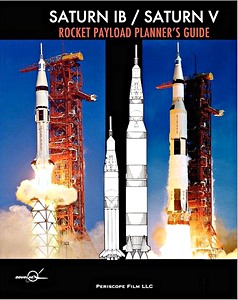
Saturn I B / Saturn V - Rocket Payload Planner's Guide

Developments of America's first heavy lift space rocket Saturn I, the Saturn IB and Saturn V propelled America's space program during the Apollo and Skylab eras. First launched in 1966, Saturn IB replaced the Saturn I's S-IV second stage with the more powerful S-IVB. It could carry a partially fueled Apollo Command / Service Module or fully fueled Lunar Module into low Earth orbit, allowing critical testing of these systems to be conducted long before the Saturn V was ready.
It also flew one orbital mission without a payload, with the extra fuel used to demonstrate that the S-IVB's J-2 engine could be restarted in zero gravity - a critical operation for translunar injection.

The Saturn IB produced thrust equivalent to 1.6 million pounds force, and could carry 46,000 pounds of payload to low Earth orbit. Saturn IB flew nine times, including three Skylab missions and for the Apollo-Soyuz Test Project. Saturn V was simply the heaviest, tallest, and most powerful rocket ever built, and capable of carrying the heaviest payload.
It could take payloads up to 100,000 pounds beyond Earth orbit or 262,000 pounds into low Earth orbit. It flew thirteen times, including eight times to the moon and (in a two-stage version) on the Skylab I mission.

First launched in 1967, the rocket consisted of three stages, with the S-IVB serving as its third stage. Taller than the Statue of Liberty, Saturn V had a mass of 3000 metric tons and five F-1 engines capable of producing thrust thrust of 7.6 million pounds-force.

Originally prepared by the Missile and Space Systems Division of NASA contractor Douglas Aircraft, this book was created to acquaint payload planners with the capabilities of the Saturn IB and Saturn V rockets.
It shows methods by which Saturn vehicles can accommodate payloads of various weights and volumes for different missions, and methods by which they might be modified to allow even greater performance. It's a wonderful reference for anyone who ever wondered how these mighty rockets were designed and built.

Dettagli del libro

Autore:Douglas Aircraft
Formato:142 pagine, 25.5 x 20.5 x 0.7 cm, brossura
Illustrazioni:riccamente illustrato con foto e disegni
Lingua:inglese
Editore:Periscope Film (USA, 2012)
ISBN:9781937684778
Copertina del libro: Saturn I B / Saturn V - Rocket Payload Planner's Guide | Periscope

Saturn I B / Saturn V - Rocket Payload Planner's Guide

Lingua: inglese

Saturn V - Flight Manual (SA 503)

Designed by Wernher von Braun and Arthur Rudolph at NASA's Marshall Space Flight Center, the Saturn V rocket represents the pinnacle of 20th Century technological achievement. The only launch vehicle in history to transport astronauts beyond Low Earth Orbit, the Saturn V delivered 24 men to the moon. To this day it holds records as the tallest (363 feet), heaviest (nearly 7 million lbs.) and most powerful (over 7.6 million pounds-force of thrust) launch vehicle ever produced. It also remains one of the most reliable, achieving 12 successful launches with one partial failure, the unmanned Apollo 6 which suffered vibration damage on lift-off, resulting in a sub-standard orbit.
The Saturn series of rockets resulted from Von Braun's work on the German V-2 and Jupiter series rockets. The Saturn I, a 2-stage liquid-fueled rocket, flew ten times between 1961 and 1965. A uprated version the 1B carried the first crewed Apollo flight into orbit in 1968. The Saturn V, which first flew in 1967, was a three-stage rocket. The first stage, which burned RP-1 and LOX, consisted of five F-1 engines. The second stage used five J-2 engines which burned LOX and liquid hydrogen (LH2). The third stage, based on the second stage of the Saturn 1B, carried a single J-2. The Saturn V could carry up to 262,000 pounds to Low Earth Orbit and more critically, 100,000 pounds to the Moon.

Created by NASA as a single-source reference as to the characteristics and functions of the Saturn V, this manual SA503 was standard issue to the astronauts of the Apollo and Skylab eras. It contains information about the Saturn V system, range safety and instrumentation,monitoring and control, prelaunch events, and pogo oscillations. It provides a fascinating overview of the rocket that made "one giant leap for mankind" possible.

Dettagli del libro

Autore:NASA
Formato:262 pagine, 25 x 20.5 x 1.4 cm, brossura
Illustrazioni:riccamente illustrato con foto e disegni
Lingua:inglese
Editore:Periscope Film (USA, 2011)
ISBN:9781935700708
Copertina del libro: Saturn V - Flight Manual (SA 503) | Periscope

Saturn V - Flight Manual (SA 503)

Lingua: inglese

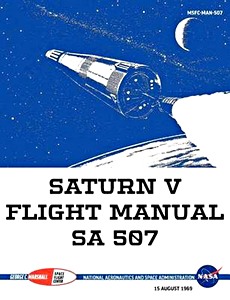
Saturn V - Flight Manual (SA 507)

Designed by Wernher von Braun and Arthur Rudolph at NASA's Marshall Space Flight Center, the Saturn V rocket represents the pinnacle of 20th Century technological achievement. The only launch vehicle in history to transport astronauts beyond Low Earth Orbit, the Saturn V delivered 24 men to the moon.
To this day it holds records as the tallest (363 feet), heaviest (nearly 7 million lbs.) and most powerful (over 7.6 million pounds-force of thrust) launch vehicle ever produced. It also remains one of the most reliable, achieving 12 successful launches with one partial failure - the unmanned Apollo 6 which suffered vibration damage on lift-off, resulting in a sub-standard orbit.

The Saturn series of rockets resulted from Von Braun's work on the German V-2 and Jupiter series rockets. The Saturn I, a 2-stage liquid-fueled rocket, flew ten times between 1961 and 1965. A uprated version the 1B carried the first crewed Apollo flight into orbit in 1968. The Saturn V, which first flew in 1967, was a three-stage rocket.
The first stage, which burned RP-1 and LOX, consisted of five F-1 engines. The second stage used five J-2 engines which burned LOX and liquid hydrogen (LH2). The third stage, based on the second stage of the Saturn 1B, carried a single J-2. The Saturn V could carry up to 262,000 pounds to Low Earth Orbit and more critically, 100,000 pounds to the Moon.

Created by NASA as a single-source reference as to the characteristics and functions of the Saturn V, this manual was standard issue to the astronauts of the Apollo and Skylab eras. It contains information about the Saturn V system, range safety and instrumentation, monitoring and control, prelaunch events, and pogo oscillations. It provides a fascinating overview of the rocket that made "one giant leap for mankind" possible.

Dettagli del libro

Autore:NASA
Formato:250 pagine, 24.5 x 19 x 1.3 cm, brossura
Illustrazioni:illustrazioni in B&N
Lingua:inglese
Editore:Books Express Publishing (GB, 2012)
ISBN:9781780398488
Copertina del libro: Saturn V - Flight Manual (SA 507) | Books Express

Saturn V - Flight Manual (SA 507)

Lingua: inglese

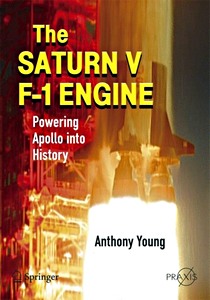
The Saturn V F-1 Engine : Powering Apollo into History

When the mighty Rocketdyne F-1 engine was conceived in the late 1950s for the U.S. Air Force, it had no defined mission and there was no launch vehicle it could power. It was a bold concept to push the technological envelope of rocket propulsion in order to put massive payloads into Earth orbit. Few realized at the time that the F-1 would one day propel American astronauts to the Moon.

In "The Saturn V F-1 Engine", Anthony Young tells the amazing story of unbridled vision, bold engineering, explosive failures during testing, unrelenting persistence to find solutions, and ultimate success in launching the Saturn V with a 100 percent success rate. The book contains personal interviews with many Rocketdyne and NASA personnel involved in the engine's design, development, testing and production. It is lavishly illustrated with black-and-white and color photographs, many never previously published.

This is the first complete history of the most powerful rocket engine ever built. The F-1 engine remains the high point in U.S. liquid rocket propulsion - it represents a period in American history when nothing was impossible.

Contents:
- Evolution of the Moon rocket
- Origin and development of the F-1 engine
- F-1 engine project management by MSFC
- F-1 engine description and operation
- Manufacturing the F-1 engine at Rocketdyne
- MSFC, Boeing and the S-IC stage
- Testing the F-1 engine and S-IC stage
- KSC and Apollo Saturn
- The F-1A: the engine that might have been.

Dettagli del libro

Autore:Anthony Young
Formato:304 pagine, 24 x 17 cm, brossura
Illustrazioni:90 foto in B&N e 50 in colori
Lingua:inglese
Editore:Springer-Verlag New York Inc. (USA, 2008)
ISBN:9780387096292
Copertina del libro: The Saturn V F-1 Engine : Powering Apollo into History | Springer (USA)

The Saturn V F-1 Engine : Powering Apollo into History

Lingua: inglese

Saturn V - Die Mondrakete

The Saturn V was the first rocket to make flights to the moon possible. The engines and almost all components were technologically new and had never been built in this size before. The intellectual father and person responsible for the successful design was the German Wernher von Braun.
The exciting story of this development up to the successful moon flights and the last Skylab missions is described competently and grippingly in this book.

Dettagli del libro

Autore:Eugen Reichl
Formato:144 pagine, 20.5 x 14 cm, brossura
Illustrazioni:46 foto in B&N e 113 in colori
Lingua:tedesco
Editore:Motorbuch Verlag (D, 2015)
ISBN:9783613037472
Copertina del libro: Saturn V - Die Mondrakete | Motorbuch

Saturn V - Die Mondrakete

Lingua: tedesco

Titoli correlati:

Copertina del libro: NASA Gemini Manual 1965-1966 (all missions, all models) - An insight into NASA's Gemini spacecraft | Haynes Space Manual

NASA Gemini Manual 1965-1966 (all missions, all models) - An insight into NASA's Gemini spacecraft

David Woods, David M Harland | inglese | copertina rigida | 176 p. | 2014