En achetant via ces liens, vous soutenez notre site sans frais supplémentaires pour vous. En savoir plus >

Navires de guerre (2e GM) - Grande Bretagne : livres

Un livre sur les navires de guerre de la Royal Navy ? Découvrez ici des livres sur l'histoire et types des navires de guerre de Grande-Bretagne de la 2e G.M..

British Warships of the Second World War : Detailed in the Original Builders' Plans

This volume reproduces a representative selection of official plans depicting the main types of warship with which the Royal Navy fought the Second World War. Carefully chosen from the incomparable collection at the National Maritime Museum, these range from battleships and fleet aircraft carriers, through cruisers, destroyers and submarines, to examples of the vast array of specialist vessels built during the war.

Concentrating on 'as fitted' drawings which show the warships as they first entered service, this collection offers an unprecedented wealth of detail on the equipment and fittings of some of the Royal Navy's most famous ships.
It also documents how their appearance changed over time, since many of the plans include alterations and additions made in different shades of ink and wash, and here printed in full colour for instant understanding of the modifications.

With an accompanying text and detailed individual captions by one of the leading experts in the field, this book provides an insight into the warship design process itself, and explains for the benefit of ship modellers and technical historians which types of plan contain the most valuable information.
For anyone with more than a passing interest in warship design and construction, this book will be a revelation.

Caractéristiques

Auteur :John Roberts
Présentation :176 pages, 29 x 24.5 cm, relié
Illustration :85 dessins en couleurs
Langue :anglais
Editeur :Pen & Sword Books Ltd (GB, 2017)
ISBN :9781473890688
Couverture du livre : British Warships of the Second World War : Detailed in the Original Builders' Plans | Pen & Sword

British Warships of the Second World War : Detailed in the Original Builders' Plans

Langue : anglais

Dunkirk Little Ships

In May 1940, following the rapid advance of German troops through Holland, Belgium and France, the British Expeditionary Force and French army retreated to Dunkirk. Operation Dynamo was instigated in an attempt to rescue as many of them as possible. With the harbour at Dunkirk severely damaged, much of the evacuation would have to take place from the beaches; only small, shallow-draught boats could do this.
After appealing to boatyards, yacht clubs and yachtsmen throughout the south east of England, the Admiralty managed to round up around 700 small craft which, along with 200 military vessels, were able to rescue an astonishing 338,226 troops over nine days.

In 1965, forty-three vessels which had taken part in the evacuation commemorated the twenty-fifth anniversary by crossing from Ramsgate to Dunkirk, and the Association of Dunkirk Little Ships was formed soon afterwards. A further fifty years on, over 120 Little Ships are still in commission and it is thought that hundreds of others may still survive.

Caractéristiques

Auteur :Nigel Sharp
Présentation :96 pages, 23.5 x 16.5 x 0.9 cm, broché
Illustration :180 photos
Langue :anglais
Editeur :Amberley Publishing (GB, 2015)
ISBN :9781445647500

A Shipyard at War - Unseen Photographs from John Brown's, Clydebank 1914 - 1918

Bien que surtout connu pour ses grands paquebots et ses navires de ligne, le chantier naval de Clydebank de John Brown & Sons a construit, entre 1914 et la fin des programmes de guerre en 1920, une vaste gamme de navires : des grands navires de guerre aux destroyers et sous-marins, en passant par des conceptions inhabituelles comme un porte-hydravions et un navire-dépôt de sous-marins, et même une série de navires marchands conformes aux normes de guerre.
Cela fait de ce chantier naval un exemple particulièrement éloquent de l'effort de construction navale en temps de guerre.

Comme la plupart des chantiers navals de l'époque, Clydebank employait des photographes professionnels pour immortaliser l'ensemble du processus de construction, utilisant des appareils photo grand format qui produisaient des images d'une clarté et d'un niveau de détail exceptionnels ; mais contrairement à la plupart des photographies de chantiers navals, la collection de Clydebank a survécu, même si relativement peu d'images ont été publiées.

Pour cet ouvrage, quelque 200 des documents les plus révélateurs ont été soigneusement sélectionnés et numérisés selon les normes les plus exigeantes, illustrant avec un niveau de détail sans précédent chaque aspect de la production du chantier naval, du paquebot Aquitania en 1914 au croiseur Enterprise, achevé en 1920.
Bien que les navires soient au cœur de l'ouvrage, les photographies témoignent également de l'impact de la guerre sur les conditions de travail dans les chantiers navals et, surtout, de l'arrivée massive des femmes parmi les employés. Grâce à des légendes détaillées et informatives, et à une introduction de référence signée Ian Johnston, ce livre dresse un portrait saisissant d'une industrie disparue à l'apogée de sa prospérité.

Caractéristiques

Auteur :Ian Johnston
Présentation :192 pages, 26 x 24 cm, relié
Illustration :200 photos
Langue :anglais
Editeur :Seaforth Publishing (GB, 2014)
ISBN :9781848322165
Couverture du livre : A Shipyard at War - Unseen Photographs from John Brown's, Clydebank 1914 - 1918 | Seaforth

A Shipyard at War - Unseen Photographs from John Brown's, Clydebank 1914 - 1918

Langue : anglais

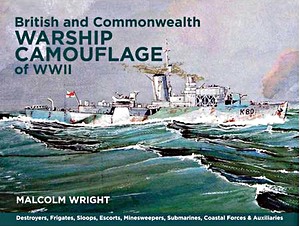
British and Commonwealth Warship Camouflage of WW II - Destroyers, Frigates, Sloops, Escorts, Minesweepers, Submarines, Coastal Forces and Auxiliaries

During the Second World War navies developed low visibility camouflage for their ships, on both the vertical and horizontal surfaces, in order reduce visibility by blending in with the sea, or confuse the identity of a ship by applying more obtrusive patters.

In this book by maritime artist Mal Wright both the official and unofficial paint schemes that adorned ships of the Royal Navy and Commonwealth are depicted in detail, along with discussion on changes of armament and electronics that effected the outward appearance of each ship.

Starting with destroyers from WW1 still in service during WW2, the book progressively covers ships below cruisers, class by class, to provide a detailed and easy-to-use guide to paint schemes in use. In some cases individual ships are shown in the several schemes they wore thus providing a source that covers various periods of service.

With 740 full colour illustrations, all of named vessels, this book concentrates information into a single volume to provide a one-stop reference source, and, for the first time in a single volume, it covers not just the well-known ships, but also escort vessels, minesweepers, trawlers, coastal craft and auxiliaries in sequential format.
Many schemes would be difficult for the reader to have found other than with the most intensive research so that historians, collectors, modelmakers and wargamers will find this unique reference source absolutely invaluable.

Caractéristiques

Auteur :Malcolm George Wright
Présentation :144 pages, 20.5 x 26 x 1.7 cm, relié
Illustration :740 illustrations en couleurs
Langue :anglais
Editeur :Seaforth Publishing (GB, 2014)
ISBN :9781848322059
Couverture du livre : British and Commonwealth Warship Camouflage of WW II - Destroyers, Frigates, Sloops, Escorts, Minesweepers, Submarines, Coastal Forces and Auxiliaries | Seaforth

British and Commonwealth Warship Camouflage of WW II - Destroyers, Frigates, Sloops, Escorts, Minesweepers, Submarines, Coastal Forces and Auxiliaries

Langue : anglais

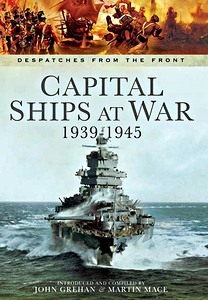
Capital Ships at War, 1939-1945 - Despatches from the Front

First time full collection of Despatches reports have been published. Despatches in this volume include those relating to:
- the sinking of the German battleship Graf Spee in the Battle of the River Plate in 1939,
- the loss of the battleships HMS Prince of Wales and HMS Repulse in the Far East,
- the sinking of the German battle cruiser Scharnhorst in 1943,
- the attack on Tirpitz by midget submarines,
- the contribution by British Pacific Fleet to the assault on Okinawa in 1945 (which included four Royal Navy battleships),
- and the sinking of Bismarck in 1941.

This unique collection of original documents will prove to be an invaluable resource for historians, students and all those interested in what was one of the most significant periods in British military history.

Caractéristiques

Auteur :John Grehan, Martin Mace
Présentation :224 pages, 24 x 15.5 x 2.1 cm, relié
Illustration :illustré
Langue :anglais
Editeur :Pen & Sword Books Ltd (GB, 2014)
ISBN :9781783462049
Couverture du livre : Capital Ships at War, 1939-1945 - Despatches from the Front | Pen & Sword

Capital Ships at War, 1939-1945 - Despatches from the Front

Langue : anglais

The Ships of Scapa Flow

Les îles entourant Scapa Flow formaient l'un des meilleurs ports naturels de Grande-Bretagne, tandis que sa situation au nord de l'Écosse protégeait les accès à la mer du Nord et à l'Atlantique.

La base navale a joué un rôle important durant les deux guerres, mais ce qui rend Scapa Flow célèbre, ce sont ses épaves, vestiges d'une flotte allemande qui comptait autrefois quelque 74 navires, dont la plupart ont été sabordés en 1919, ainsi que les tombes de guerre du HMS Royal Oak et du HMS Vanguard.

Les épaves des navires de la marine subsistent encore, ainsi que celles de huit navires de guerre allemands dont le renflouement a été impossible en raison d'une seconde guerre. Devenues un paradis pour les plongeurs, les épaves de Scapa Flow attirent des plongeurs du monde entier et emploient de nombreux habitants des Orcades.

Voici l'histoire des navires de Scapa Flow, de leur naufrage et de leur sauvetage, illustrée par de nombreuses images inédites de la récupération et du transfert ultérieur de nombreux cuirassés et croiseurs allemands au chantier naval de Rosyth, dans le Fife, en vue de leur démantèlement.

Caractéristiques

Auteur :Campbell McCutcheon
Présentation :96 pages, 23.5 x 18.5 x 0.9 cm, broché
Illustration :illustré
Langue :anglais
Editeur :Amberley Publishing (GB, 2013)
ISBN :9781445633862

J. Samuel White & Co., Shipbuilders

J. Samuel White & Company était la plus ancienne entreprise figurant sur la liste de l'Amirauté et a construit 252 navires pour la seule Royal Navy. La fermeture du chantier naval en 1966 a mis fin à 300 ans de construction navale durant lesquels l'entreprise s'est forgée une solide réputation auprès des clients marchands et militaires.

Célèbre dès ses débuts pour ses patrouilleurs rapides des douanes et ses bricks, la Royal Navy s'est illustrée, durant ses dernières années, par ses destroyers. Très novatrice, elle a développé et breveté de nombreux produits pionniers, parmi lesquels des moteurs semi-diesel, des échangeurs de chaleur, des climatiseurs et des compresseurs, ainsi qu'une gamme de propulseurs marins.

L'entreprise construisait non seulement des navires et des bateaux, mais aussi une gamme d'aéronefs maritimes. Durant la Première Guerre mondiale, la production de White s'éleva à 100 navires, dont 27 destroyers, et 201 hydravions. Durant la Seconde Guerre mondiale, elle produisit 317 navires, parmi lesquels 26 destroyers et un important mouilleur de mines.

Illustré de photographies de ces produits et de nombreux autres produits de l'entreprise, ce livre raconte l'histoire de J. Samuel White et de ses filiales, une entreprise bâtie sur une réputation de qualité qui lui a valu le slogan : "White's-built - well-built !".

Caractéristiques

Auteur :David Williams, Richard P. de Kerbrech
Présentation :176 pages, 23.5 x 16.5 x 1.2 cm, broché
Illustration :illustré
Langue :anglais
Editeur :The History Press Ltd (GB, 2012)
ISBN :9780752466125
Couverture du livre : J. Samuel White & Co., Shipbuilders | The History Press

J. Samuel White & Co., Shipbuilders

Langue : anglais

Autres livres dans cette catégorie :