Al comprar mediante los enlaces, apoyas este sitio sin coste adicional para usted. Más información >

Automotores - Alemania (1945-1994): libros - historia

Libros sobre la historia, modelos y técnica de los automotores diésel y eléctricos y los autobuses ferroviarios de la Deutsche Bundesbahn (1945-1994).

Der deutsche Pendolino - Die Baureihe 610

In the late 1980s, the Nuremberg BD evaluated improvements for regional routes in Upper Franconia and Upper Palatinate, particularly from Nuremberg to Bayreuth and Hof. Both electric and diesel operation were examined.

In 1988, it was determined that a diesel train with tilting technology could achieve comparable travel time improvements to an electric train, but with lower investment. This is how the diesel multiple unit 610 was created.
Under BZA Munich, MAN / MBB / DUEWAG (MAN in charge) managed the carriage construction, while SIEMENS / BBC / AEG (Siemens in charge) took over the electrical part. Bogies and tilting technology were supplied by Fiat Ferroviaria.

By May 1992, nine 610 multiple units were available, and another was used as a test train. By the beginning of 1993, all 20 trains had been delivered, enabling the planned addition in Upper Palatinate in May 1993. Since then, the 610 multiple units have been in tireless use in north-east Bavaria, have covered over 100 million km and significantly improved regional transport. They increased passenger numbers by almost 50% and served as a model throughout the Federal Republic.

Dipl.-Ing. Matthias Maier, who played a key role in the development, presents a comprehensive portrait of the reliable trains, including construction, commissioning, operational launch and test runs up to 280 km/h with tilting technology bogies for the later 605 series (ICE TD).

Detalle del libro

Autor:Matthias Maier
Presentación:96 páginas, 17 x 24 x 1.5 cm, tapa dura
Ilustración:96 fotos y color
Idioma:Alemán
Editorial:EK-Verlag GmbH (D, 2014)
Colección:Eisenbahn-Bildarchiv (64)
ISBN:9783882554663
Portada del libro: Der deutsche Pendolino - Die Baureihe 610 | Eisenbahn-Bildarchiv (64) | EK

Der deutsche Pendolino - Die Baureihe 610

Idioma: Alemán

Ver ofertas:

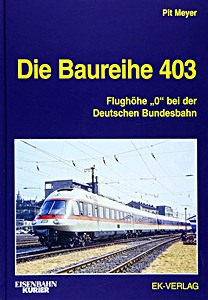
Die Baureihe 403 - Flughöhe '0' bei der Deutschen Bundesbahn

From 1969, DB designed the electric express train of the 403/404 series for the new IC network. As the "train of the future", it was given a streamlined head shape and nicknames such as "Donald Duck" or "great white shark".
These three trains were in service in the scheduled intercity service between Munich and Bremen from September 1974 to May 1979, with their exceptionally high mileage of over 1, 500 km/day being due to the long route and two daily rotations. A series order was not made.

DB and Lufthansa cooperated from 1981, and the three sets began their second operational career on March 27, 1982 as the "Lufthansa Airport Express" between Frankfurt and Düsseldorf. The jet-like appearance of the ET 403 was a perfect match for this "flight at altitude 0". The cooperation ended in 1993.

This EK Baureihe-series book describes in detail the development of the ET 403, combined with innovations in vehicle construction and tried-and-tested electrical components.
The operational history, the various stations, the long service life and the finally realized refurbishment of the ET 403 are traced in detail and excitingly in this book.

Detalle del libro

Autor:Pit Meyer
Presentación:248 páginas, 30 x 21.5 x 2.2 cm, tapa dura
Ilustración:390 fotos y dibujos
Idioma:Alemán
Editorial:EK-Verlag GmbH (D, 2018)
Colección:EK-Baureihenbibliothek
ISBN:9783844660289
Portada del libro: Die Baureihe 403 - Flughöhe '0' bei der Deutschen Bundesbahn | EK-Baureihenbibliothek | EK

Die Baureihe 403 - Flughöhe '0' bei der Deutschen Bundesbahn

Idioma: Alemán

Ver ofertas:

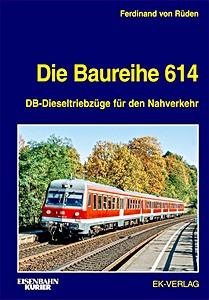
Die Baureihe 614 - DB-Dieseltriebzüge für den Nahverkehr

For almost 35 years, the iconic diesel railcars of the 614 series, from their long-standing locations in Nuremberg and Braunschweig, reliably shaped regional and district transport in their traditional areas of operation.
The railcars, which appeared in a total of four paint variants, were not only technically impressive, but also aesthetically pleasing.

Deutsche Bahn used the last examples of the 614 series in the Franconian region until 2010, mainly for additional trips in the early morning hours. Today, only the two multiple units of the 719 series, which are classified as railway service vehicles, still operate in Germany.
A considerable number of the vehicles were sold to Poland and Romania, where they found new areas of use after being refurbished.

The remarkable continuity in home service, the striking appearance and the characteristic sound of the original MAN engines characterize the 42 units of this series. This series book pays tribute to the solid diesel multiple units of the 614 series and, ten years after their end of service, closes a significant gap in the EK library with numerous previously unpublished illustrations.

Detalle del libro

Autor:Ferdinand von Rüden
Presentación:224 páginas, 29.5 x 20.5 x 2.4 cm, tapa dura
Ilustración:453 fotos y dibujos
Idioma:Alemán
Editorial:EK-Verlag GmbH (D, 2021)
Colección:EK-Baureihenbibliothek
ISBN:9783844660432
Portada del libro: Die Baureihe 614 - DB-Dieseltriebzüge für den Nahverkehr | EK-Baureihenbibliothek | EK

Die Baureihe 614 - DB-Dieseltriebzüge für den Nahverkehr

Idioma: Alemán

Ver ofertas:

Die Baureihe VT 10.5 - Die Gliedertriebzüge Senator' und 'Komet' der Deutschen Bundesbahn

When the lifting of the ban on the development and construction of new rail vehicles imposed by the Allies after the end of the war in 1945 became foreseeable, the pioneer of the rapid transit concept, Franz Kruckenberg, and the Reichsbahn in the United Economic Area, later the Deutsche Bundesbahn (DB), made initial contact in March 1948.
President Frohne campaigned for the continuation of the successful railcar construction of the pre-war period and supported the resulting concept of light metal articulated multiple units.
Linke-Hofmann-Busch (LHB) built a day train (VT 10 501) on behalf of the DB, while Wegmann manufactured a night train (VT 10 551) for the Deutsche Schlafwagen- and Speisewagengesellschaft (DSG).

Both trains, initially seven-carriage, had a largely identical drive concept with truck engines, hydromechanical transmissions and cardan shafts. The sleeping car train rested on Jakobs bogies, while the day train was given Kruckenberg's single-axle running gear for the separation points between the sections.
The book deals with the groundbreaking innovations of the time, including wider carriages, spacious interiors, air conditioning and an enclosed toilet.

Presented at the German Transport Exhibition in Munich in 1953, the trains became advertising vehicles for the new Federal Republic. Although not all expectations were met and they were withdrawn from scheduled service early, they paved the way for further projects for the companies involved, such as LHB, MAN and Wegmann, including the DB's TEE multiple unit (VT 11.5) from May 1957.

Detalle del libro

Autor:Heinz Kurz
Presentación:200 páginas, 30 x 21.5 x 1.7 cm, tapa dura
Ilustración:ricamente ilustrado
Idioma:Alemán
Editorial:EK-Verlag GmbH (D, 2016)
Colección:EK-Baureihenbibliothek
ISBN:9783844660258
Portada del libro: Die Baureihe VT 10.5 - Die Gliedertriebzüge Senator' und 'Komet' der Deutschen Bundesbahn | EK-Baureihenbibliothek | EK

Die Baureihe VT 10.5 - Die Gliedertriebzüge Senator' und 'Komet' der Deutschen Bundesbahn

Idioma: Alemán

Ver ofertas:

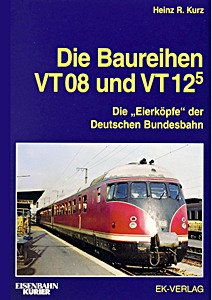
Die Baureihen VT 08 und VT 12.5 - Die 'Eierköpfe' der Deutschen Bundesbahn'

They acquired cult status among railway enthusiasts, but after just ten years they became an early victim of electrification: the first diesel railcars built for the German Bundesbahn after 1945, the VT 08 for long-distance traffic and the VT 12 for regional traffic.

The period from the start of development to the decommissioning spanned almost forty years: after being used in high-quality F-train traffic and temporarily in TEE services as well as in long-distance district traffic, they gradually migrated to the "provinces" of Lower Saxony and Schleswig-Holstein after just a few years.
After the turning point in 1945, the VT 08 were also the first German vehicles that could travel to western countries such as Paris, Amsterdam, Ostend or Zurich.

This series book describes the technical development of the railcars from 1948, not forgetting the test vehicles VT 20.5 and the experimental railcar VT 92.5, and gives a detailed overview of the operational history from the "Münchner Kindl" in 1952 to the "Kopenhagen Express" in 1954 to the decommissioning in 1985 and the two preserved museum trains.
The six VT 08.8 saloon and hospital railcars built for the US Army also have their place. Information on the home of the railcars and their schedules complement the operational picture.

Detalle del libro

Autor:Heinz R. Kurz
Presentación:248 páginas, 30 x 20.5 x 2.5 cm, tapa dura
Ilustración:412 fotos en b/n y color
Idioma:Alemán
Editorial:EK-Verlag GmbH (D, 2018)
Colección:EK-Baureihenbibliothek
ISBN:9783844660333
Portada del libro: Die Baureihen VT 08 und VT 12.5 - Die 'Eierköpfe' der Deutschen Bundesbahn' | EK-Baureihenbibliothek | EK

Die Baureihen VT 08 und VT 12.5 - Die 'Eierköpfe' der Deutschen Bundesbahn'

Idioma: Alemán

Ver ofertas:

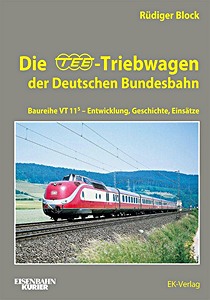
Die TEE-Triebwagen der Deutschen Bundesbahn - Baureihe VT 11.5 - Entwicklung, Geschichte, Einsätze

The VT 115 series railcars once ushered in a new era for the German Bundesbahn: that of international TEE traffic! For more than ten years, their use was associated with such illustrious names as "Helvetia" or "Parsifal". After being "demoted" to IC honors, they were then used as the "Alpen-See-Express" in the 1980s in tourist traffic between northern Germany and the southern German holiday resorts.
Even after around 30 years of intensive use, the former TEE railcars were still very popular. It is therefore not surprising that even after they were decommissioned in 1988, they still caused a stir, whether as a luxury train in Italy or - briefly returned to Germany - as the "Max Liebermann" between Berlin and Hamburg.

With this book, the renowned specialist author Rüdiger Block has created a worthy monument to the former TEE railcar. In addition to the comprehensive presentation of the technology and the operational history of the VT 11.5/601 and the gas turbine trains of the 602 series, the foreign TEE railcars and the Danish variant of the VT 115 are also described in detail.
Numerous original documents and a representative picture section in the well-known EK quality round off the portrait of this beautifully designed railcar.

Detalle del libro

Autor:Rüdiger Block
Presentación:296 páginas, 29.5 x 21 x 2.8 cm, tapa dura
Ilustración:422 fotos y dibujos
Idioma:Alemán
Editorial:EK-Verlag GmbH (D, 2022)
ISBN:9783844660562
Portada del libro: Die TEE-Triebwagen der Deutschen Bundesbahn - Baureihe VT 11.5 - Entwicklung, Geschichte, Einsätze | EK

Die TEE-Triebwagen der Deutschen Bundesbahn - Baureihe VT 11.5 - Entwicklung, Geschichte, Einsätze

Idioma: Alemán

Ver ofertas:

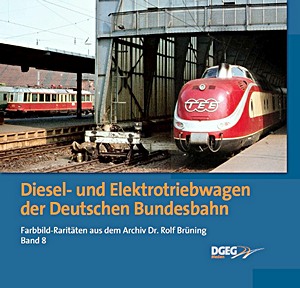
Diesel- und Elektrotriebwagen der Deutschen Bundesbahn

This eighth volume of "Farbbild-Raritäten" is dedicated to the railcars of the German Bundesbahn. These include vehicles taken over from pre-war stocks as well as those newly developed before the transfer to Deutsche Bahn AG on January 1, 1994.
In addition to introductory texts, the book offers a selection of impressive photos, the oldest of which bring the early days of the Bundesbahn back to life with their colorful mixture of Reichsbahn types and new "egg heads", with the legendary TEE (VT 11.5) or the various rail buses, and then span the new regional railcars of the 1980s to the first generation of high-speed trains.
At the end of the book, some unusual rail service railcars are presented.

Detalle del libro

Autor:Rolf Brüning
Presentación:156 páginas, 22 x 24 cm, tapa dura
Ilustración:150 fotos y color
Idioma:Alemán
Editorial:DGEG Medien GmbH (D, 2013)
ISBN:9783937189710
Portada del libro: Diesel- und Elektrotriebwagen der Deutschen Bundesbahn | DGEG Medien

Diesel- und Elektrotriebwagen der Deutschen Bundesbahn

Idioma: Alemán

Ver ofertas:

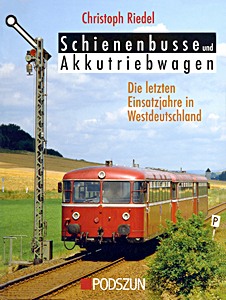
Schienenbusse und Akkutriebwagen - Die letzten Einsatzjahre in Westdeutschland

Which of the older railway enthusiasts does not remember the years when rail buses quickly replaced steam locomotives on numerous branch lines?
The author shows and explains the basic features and their history of use. An illustrated book about the end of the ETA 150 and VT 98 series, about two outstanding eras in German railway history.

From the contents:
History of origin and use
Last areas of use in western Germany (timetable route numbers from 1985):
- Sauerland and Siegerland (KBS 361, 352, 363 and 362)
- Hessian mountain country (KBS 362/section Bad Laasphe-Marburg, KBS 366, 368, 530, 532, 422, 365, 423, 424)
- Eifel and on the Moselle (KBS 602, 621, 444)
- Lower Rhine (KBS 457, 443, 472, 441)
- Ruhr area (KBS 388, 308, 384, 383)
- Münsterland (KBS 284, 315, 286)
- Bergisches Land (KBS 402, 411, 401)
- Special trips
- Successors and vehicle data of the railcars in use today.

Detalle del libro

Autor:Christoph Riedel
Presentación:126 páginas, 28 x 21 cm, tapa dura
Ilustración:320 fotos en b/n y color
Idioma:Alemán
Editorial:Verlag Podszun (D, 2008)
ISBN:9783861334965
Portada del libro: Schienenbusse und Akkutriebwagen - Die letzten Einsatzjahre in Westdeutschland | Podszun

Schienenbusse und Akkutriebwagen - Die letzten Einsatzjahre in Westdeutschland

Idioma: Alemán

Ver ofertas:

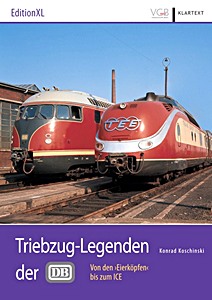
Triebzug-Legenden der DB - Von den 'Eierköpfen' zum ICE

VT 08.5, VT 11.5, ET 403, InterCity-Experimental - from the early 1950s to the late 1980s, legendary designs have shaped the history of multiple units at DB.
It all began when DB put its first new streamlined multiple units into service in April 1952, which later earned the nickname "eggheads". With their elegant design, VT 08.5 and VT 12.5, ET 30 and ET 56 were synonymous with progress on rails.

In the 1960s, the VT 11.5 became a legend that stood for speed, design and luxury. As the flagship of the TEE network, it ran to Milan and Zurich, Amsterdam, Ostend and Paris.
And in 1985, the InterCity Experimental (ICE) was finally put into service, the prototype of a new generation of high-speed multiple units that still shape the image of long-distance rail transport today.

Separate chapters of this 240-page collection, which is based on the popular special editions of the Eisenbahn-Journal, are devoted to the futuristic but short-lived articulated trains "Komet" and "Senator" of the VT 10.5 series and the ET 403, which was nicknamed "Donald Duck" by railway fans and connected the airports of Düsseldorf and Frankfurt between 1982 and 1993 as the Lufthansa Airport Express.

Detalle del libro

Autor:Konrad Koschinski
Presentación:240 páginas, 29.5 x 21 cm, tapa blanda
Ilustración:400+ fotos en b/n y color
Idioma:Alemán
Editorial:VGB GmbH (D, 2016)
ISBN:9783837517293
Portada del libro: Triebzug-Legenden der DB - Von den 'Eierköpfen' zum ICE | VGB

Triebzug-Legenden der DB - Von den 'Eierköpfen' zum ICE

Idioma: Alemán

Ver ofertas:

También te puede interesar:

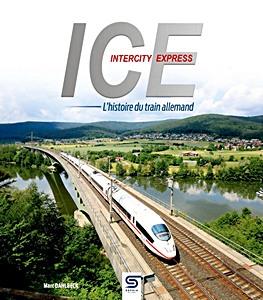
Portada del libro: ICE, l'histoire du train allemand

ICE, l'histoire du train allemand

Marc Dahlbeck | Francés | tapa blanda | 144 pág. | 2023

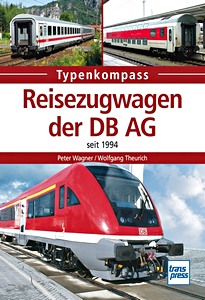
Portada del libro: Reisezugwagen der DB AG - seit 1994 | Typenkompass

Reisezugwagen der DB AG - seit 1994

Peter Wagner , Wolfgang Theurich | Alemán | tapa blanda | 128 pág. | 2015

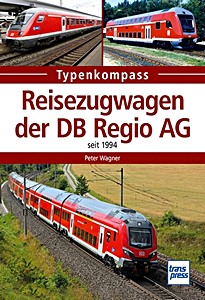
Portada del libro: Reisezugwagen der DB Regio AG - seit 1994 | Typenkompass

Reisezugwagen der DB Regio AG - seit 1994

Peter Wagner | Alemán | tapa blanda | 128 pág. | 2018

Portada del libro: Die elektrischen Nahverkehrstriebzüge der Deutschen Bahn

Die elektrischen Nahverkehrstriebzüge der Deutschen Bahn

Karl Gerhard Baur | Alemán | tapa dura | 272 pág. | 2010

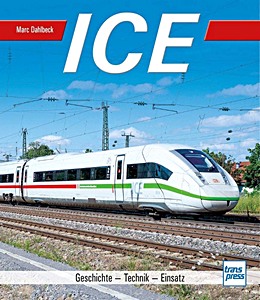
Portada del libro: ICE - Geschichte, Technik, Einsatz

ICE - Geschichte, Technik, Einsatz

Marc Dahlbeck | Alemán | tapa dura | 144 pág. | 2022