Acquistando tramite i link, sostieni nostro sito senza alcun costo aggiuntivo per te. Per saperne di più >

Navi da guerra - Italia: libri di storia illustrati

Un libro sulle navi da guerra della Regia Marina? Scopri qui i libri illustrati sulla storia e le tipologie di navi da guerra italiane.

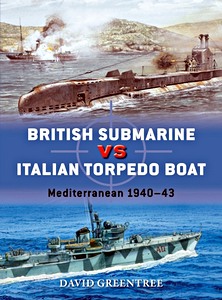
British Submarine vs Italian Torpedo Boat : Mediterranean 1940-43 (Osprey)

As the war in North Africa escalated, Axis war efforts became increasingly dependent on supply lines across the Mediterranean. To try to cut off these lines of supply the British deployed submarines from the besieged island of Malta with the directive to sink as much merchant convoy tonnage as possible. Italy responded by sending her Torpedo boats to protect and escort Axis convoys.

Featuring specially commissioned full-colour artwork and carefully chosen archive photographs, this engaging study assesses the evolving battle between Britain's submarines and Italy's torpedo boats in the struggle for primacy in the Mediterranean at the height of World War II.

Contents: Introduction - Chronology - Design and Development - The Strategic Situation - Technical Specifications - The Combatants - Combat - Statistics and Analysis - Conclusion - Further Reading - Index.

Dettagli del libro

Autore:David Greentree
Formato:80 pagine, 25 x 18.5 x 0.8 cm, brossura
Illustrazioni:45 foto in B&N e 16 in colori
Lingua:inglese
Editore:Osprey Publishing (GB, 2016)
Collana:Duel (74)
ISBN:9781472814128
Copertina del libro: British Submarine vs Italian Torpedo Boat : Mediterranean 1940-43 | Duel (74) | Osprey

British Submarine vs Italian Torpedo Boat : Mediterranean 1940-43

Lingua: inglese
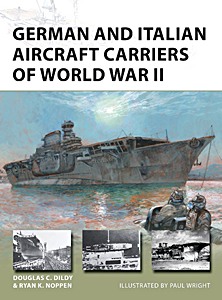
German and Italian Aircraft Carriers of World War II (Osprey)

The quest for a modern aircraft carrier was the ultimate symbol of the Axis powers' challenge to Allied naval might, but fully-fledged carriers proved either too difficult, expensive, or politically unpopular for either to make operational.
After the Anglo-German Naval Agreement of 1935, Hitler publicly stated his intention to build an aircraft carrier, the Graf Zeppelin, which was launched in 1938. A year later, the ambitious fleet-expansion Z-Plan, was unveiled with two additional aircraft carriers earmarked for production.
However, by the beginning of World War II, Graf Zeppelin was not yet completed and work was halted.
Further aircraft carrier designs and conversion projects such as the ocean liner Europa and heavy cruiser Seydlitz were considered but, in January 1943, all construction work on surface vessels ceased and naval resources were diverted to the U-boat Campaign.

This book explains not only the history of Germany's famous Graf Zeppelin fleet carrier and German carrier conversion projects but also Italy's belated attempt to convert two of her ocean liners into carriers.
It considers the role of naval aviation in the two countries' rearmament programs, and describes how ultimately it was only Italian seaplane carriers and German ocean-going, catapult-equipped flying boat carriers that both Axis powers did eventually send into combat.

Dettagli del libro

Autore:Ryan K. Noppen, Douglas C. Dildy, Paul Wright
Formato:48 pagine, 24.5 x 18.5 x 0.6 cm, brossura
Illustrazioni:40 foto in B&N, 8 pagine disegni in colori
Lingua:inglese
Editore:Osprey Publishing (GB, 2022)
Collana:New Vanguard
ISBN:9781472846761
Copertina del libro: German and Italian Aircraft Carriers of World War II | New Vanguard | Osprey

German and Italian Aircraft Carriers of World War II

Lingua: inglese

Italian Destroyers of World War II (Osprey)

The Italian Royal Navy (Regia Marine or RM) began the Second World War with one of the largest fleets in the world. Included in this was a total of 59 fleet destroyers, and others were added during the war. These were a diverse collection of ships dating back to the First World War, large destroyers built to counter ships of similar size being introduced in the French Navy (the RM's historical enemy), and medium-sized ships which constituted the bulk of the destroyer force.

RM destroyers were built for high speed, not endurance since they were only expected to operate inside the Mediterranean. They were also well-armed, but lacked radar. During the war, RM destroyers fought well.
With the exception of a small force based in Abyssinia which fought a series of battles in the Red Sea against the British, RM destroyers were active in the Mediterranean. The primary mission of the RM curing the war was to keep the supply lines to North Africa open. The Italians were largely successful in this effort, and destroyers were key in the effort.
RM destroyers were present at every fleet action with the British Mediterranean Fleet.. The intensity of these actions were shown by the fact that the RM lost 51 destroyers during the war.

Dettagli del libro

Autore:Mark E. Stille
Formato:48 pagine, 24.5 x 18.5 x 1.5 cm, brossura
Illustrazioni:40 foto in B&N, disegni in colori
Lingua:inglese
Editore:Osprey Publishing (GB, 2021)
Collana:New Vanguard
ISBN:9781472840554
Copertina del libro: Italian Destroyers of World War II | New Vanguard | Osprey

Italian Destroyers of World War II

Lingua: inglese

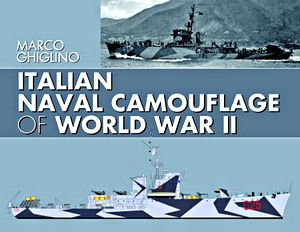
Italian Naval Camouflage of World War II

A major new study of Italian naval camouflage schemes developed and used during World War Two. When Italy entered the War in June 1942, the Regia Marina (Italian navy) was a force still under development and both Italian warships and merchant ships faced the War in their peace colours; and nor had any had prewar plans been made for camouflaging ships.
At that time all the principal warships were painted in a light matt grey ('grigio cenerino chiaro'), which had been adopted in the 1920s and early '30s.
With the advent of War, and the start of convoy traffic to Libya, the need to camouflage ships for purposes of deception, rather than outright concealment, became apparent and the first initiatives were undertaken.

In the first part of the book, employing contemporary schematic drawings, photographs and his own CAD profiles, the author describes the development of the varied schemes that were adopted for the capital ships, such as Caio Duilia and Littorio, cruisers, destroyers and torpedo boats, landing craft and merchant ships; even the royal yacht and small tugs were given camouflage schemes.

In the second, and longest, part he depicts all the ships and their schemes, at different dates, with both sides of a ship shown where possible, in his own beautifully rendered schematic profiles, all in full colour, and it is this section with more than 700 drawings that gives the reader a complete and detailed picture of the whole development of Italian naval camouflage.
He also looks in detail at the Greek theatre where there were many exceptions, influenced by the German presence and by the camouflage schemes of captured vessels. T

his major new reference book will prove invaluable to historians, collectors, modelmakers and wargamers and follows in the wake of the hugely successful Seaforth editions covering German and British camouflage schemes of the Second World War.

Dettagli del libro

Autore:Marco Ghiglino
Formato:256 pagine, 20.5 x 26.5 x 2.5 cm, copertina rigida
Illustrazioni:750 foto in B&N e in colori, viste di profilo in colori
Lingua:inglese
Editore:Pen & Sword Books Ltd (GB, 2018)
ISBN:9781526735393
Copertina del libro: Italian Naval Camouflage of World War II | Pen & Sword

Italian Naval Camouflage of World War II

Lingua: inglese

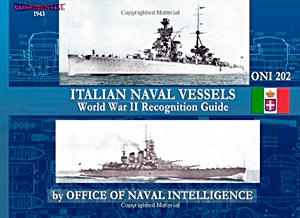
Italian Naval Vessels: WWII Recognition Guide

Originally printed in 1943, ONI 202 Italian Naval Vessels presents a categorical description of the various Italian warships that comprised the Regia Marina during WWII.
Created by the Office of Naval Intelligence, it was one of a series of classified recognition guides produced for officers and staff. It contains numerous data tables, designation information, and dozens of illustrations compiled from a wide variety of sources, including intelligence reports and reconnaissance photographs.

The book includes the full catalog of ships in service ranging from the Cavour and Littorio class battleships to the cruisers, destroyers, submarines, mine vessels, torpedo boats, transports and tenders that serviced the fleet.
ONI 202 is surprising in its range and detail. Browsing through its pages you'll find silhouettes, photographs and photos of models, airbrushed renderings and drawings, and detailed plans and profiles of various classes of warship, making this a must-have book for the historian and modeler.
This high quality reprint of this now-declassified book is slightly reformatted but presents the original text in its entirety.

Dettagli del libro

Autore:US Office of Naval Intelligence (ONI)
Formato:92 pagine, 15.5 x 21 x 0.5 cm, brossura
Illustrazioni:riccamente illustrato con foto e disegni
Lingua:inglese
Editore:Periscope Film (USA, 2013)
ISBN:9781940453255
Copertina del libro: Italian Naval Vessels: WWII Recognition Guide | Periscope

Italian Naval Vessels: WWII Recognition Guide

Lingua: inglese

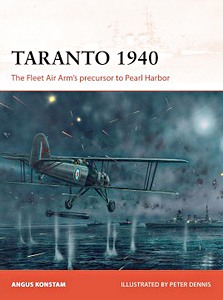
Taranto 1940 : The Fleet Air Arm's Precursor to Pearl Harbor (Osprey)

The Royal Navy's attack on Taranto in 1940 heralded a new age of warfare. It was the decisive moment in a struggle for dominance of the Mediterranean that had gone on for months, as the British and Italian navies both looked to secure maritime supply routes for their colonies.

With the enormous demands of a global war beginning to tell, the British capital ships were simply too thinly spread for a large fleet action against Taranto, where the bulk of the Italian fleet lay menacingly. How was the Royal Navy to eliminate the threat of the Regia Marina?

This is the story of one of World War II's most devastating raids, recounting how a handful of obsolete Fairey Swordfish biplanes swooped in and destroyed an Italian battleship and badly damaged two more.
With expert analysis, detailed colour illustrations and a gripping narrative, this book explains the origins of the attack, its planning and execution, and what happened in the aftermath.

Contents: Origins of the campaign - Chronology - Opposing commanders - Opposing armies - Orders of battle - Opposing plans - The operation - Aftermath - The battlefields today - Further reading - Index.

Dettagli del libro

Autore:Angus Konstam
Formato:96 pagine, 25 x 18.5 x 0.8 cm, brossura
Illustrazioni:riccamente illustrato con foto e disegni (in B&N e in colori)
Lingua:inglese
Editore:Osprey Publishing (GB, 2015)
Collana:Campaign (288)
ISBN:9781472808967
Copertina del libro: Taranto 1940 : The Fleet Air Arm's Precursor to Pearl Harbor | Campaign (288) | Osprey

Taranto 1940 : The Fleet Air Arm's Precursor to Pearl Harbor

Lingua: inglese

Italienische Kriegsschiffe 1919-1943 (Typenkompass)

The Italian Navy was created after the unification of Italy in the 1860s. In the First World War, on the side of the victorious powers, Italy was able to expand its fleet and use it to support its colonial ambitions in North Africa. In the Second World War, the Italian Navy was given important tasks in the Mediterranean.

Pagine del libro [TK] Italienische Kriegsschiffe 1919-1943 (1)

Pagine del libro "Italienische Kriegsschiffe 1919-1943"

In this Typenkompass, Gabriele Faggioni presents all the important ships of the Italian Navy that were used from the end of the First World War until Italy's capitulation in 1943. Each type is presented with a photo, a historical description and a technical data sheet.

Dettagli del libro

Autore:Gabriele Faggioni
Formato:128 pagine, 20.5 x 14 cm, brossura
Illustrazioni:123 foto in B&N, 8 disegni
Lingua:tedesco
Editore:Motorbuch Verlag (D, 2013)
Collana:Typenkompass
ISBN:9783613035515
Copertina del libro: Italienische Kriegsschiffe 1919-1943 | Typenkompass | Motorbuch

Italienische Kriegsschiffe 1919-1943

Lingua: tedesco

Titoli correlati:

Copertina del libro: British Battleship vs Italian Battleship : The Mediterranean 1940-41 | Duel

British Battleship vs Italian Battleship : The Mediterranean 1940-41

Mark Stille | inglese | brossura | 80 p. | 2020

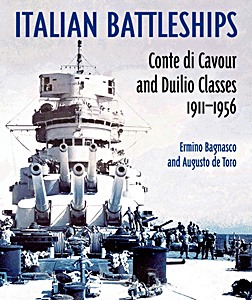
Copertina del libro: Italian Battleships - Conte di Cavour and Duilio Classes 1911-1956

Italian Battleships - Conte di Cavour and Duilio Classes 1911-1956

Erminio Bagnasco, Augusto De Toro | inglese | copertina rigida | 272 p. | 2021

Copertina del libro: Italian Battleships of World War II | New Vanguard (182)

Italian Battleships of World War II

Mark Stille | inglese | brossura | 48 p. | 2011