Acquistando tramite i link, sostieni nostro sito senza alcun costo aggiuntivo per te. Per saperne di più >

Navi da guerra (XIX e XX secolo): libri di storia illustrati

Un libro sulle navi da guerra? Scopri libri illustrati sulla storia, i modelli e la tecnologia delle navi da guerra del XIX e XX secolo.

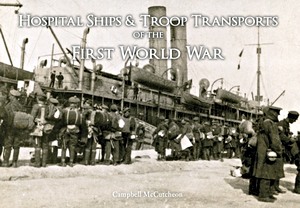
Hospital Ships and Troop Transport of the First World War

The biggest shipping loss of both world wars was the hospital ship Britannic, at almost 50,000 tons. Supposedly safe to travel the seas, many hospital ships were lost in both wars.
From the smallest of motor launches through steam yachts and converted ocean liners, Campbell McCutcheon tells the story of the First World War hospital ships. Many succumbed to accidents, mines or German submarines but many also faithfully provided a vital service without loss of life or accident.

Troopships were also vital right from the very first days of the war, when ships carried the BEF across the English Channel in August 1914. Meanwhile, convoys that included many great pre-war ocean liners pressed into service were bringing Canadian and Australasian troops to the UK and France, and later American troops as well.
Many would continue in service until long after the war had ended, repatriating soldiers well into 1919, and their story is also told in this beautifully illustrated book.

Dettagli del libro

Autore:Campbell McCutcheon
Formato:128 pagine, 16.5 x 24.5 x 1.4 cm, brossura
Illustrazioni:200 foto in B&N
Lingua:inglese
Editore:Amberley Publishing (GB, 2015)
ISBN:9781445638676
Copertina del libro: Hospital Ships and Troop Transport of the First World War | Amberley

Hospital Ships and Troop Transport of the First World War

Lingua: inglese

Naval Anti-Aircraft Guns and Gunnery

This book does for naval anti-aircraft defence what the author's Naval Firepower did for surface gunnery - it makes a highly complex but historically crucial subject accessible to the layman.
It chronicles the growing aerial threat from its inception in the First World War and the response of each of the major navies down to the end of the Second, highlighting in particular the widely underestimated danger from dive-bombing.

Central to this discussion is an analysis of what effective AA fire-control required, and how well each navy's systems actually worked. It also takes in the weapons themselves, how they were placed on ships, and how this reflected the tactical concepts of naval AA defence.
As would be expected from any Friedman book, it offers striking insights - he argues, for example, that the Royal Navy, so often criticised for lack of 'air-mindedness', was actually the most alert to the threat, but that its systems were inadequate not because they were too primitive but because they tried to achieve too much.

The book summarises the experience of WW2, particularly in theatres where the aerial danger was greatest, and a concluding chapter looks at post-1945 developments that drew on wartime lessons.
All important guns, directors and electronics are represented in close-up photos and drawings, and lengthy appendices detail their technical data. It is, simply, another superb contribution to naval technical history by its leading exponent.

Dettagli del libro

Autore:Norman Friedman
Formato:399 pagine, 29.5 x 25.5 x 3 cm, copertina rigida
Illustrazioni:350 foto e disegni
Lingua:inglese
Editore:Seaforth Publishing (GB, 2014)
ISBN:9781848321779
Copertina del libro: Naval Anti-Aircraft Guns and Gunnery | Seaforth

Naval Anti-Aircraft Guns and Gunnery

Lingua: inglese

Torpedo - The Complete History of the World's Most Revolutionary Naval Weapon

The torpedo was the greatest single game-changer in the history of naval warfare. For the first time it allowed any small, cheap torpedo-firing vessel - and by extension a small, minor navy - to threaten the largest and most powerful warships afloat. The traditional concept of seapower, based on huge fleets of expensive capital ships, required radical rethinking.
It had long been understood that the most effective way of sinking a ship is to make a hole below the waterline, but centuries of experiments had failed to produce an effective method of achieving this. After many false starts and developmental cul-de-sacs, the answer proved to be the 'locomotive' or self-propelled torpedo, which became a practical proposition in the late nineteenth century.

This book is a broad-ranging international history of the weapon, tracing not only its origins and technical progress down to the present day, but also its massive impact on all subsequent naval wars.
"Torpedo" is the first dedicated study of this highly significant subject for over thirty years, a period in which much new information has come to light and the capabilities of the weapon itself have improved beyond recognition. Because of the crucial importance of the torpedo in naval history, this is a book no enthusiast or historian can afford to miss.

Dettagli del libro

Autore:Roger Branfill-Cook
Formato:256 pagine, 28.5 x 22 x 2.1 cm, copertina rigida
Illustrazioni:200 foto e disegni
Lingua:inglese
Editore:Seaforth Publishing (GB, 2014)
ISBN:9781848322158
Copertina del libro: Torpedo - The Complete History of the World's Most Revolutionary Naval Weapon | Seaforth

Torpedo - The Complete History of the World's Most Revolutionary Naval Weapon

Lingua: inglese

Titoli correlati:

Copertina del libro: Histoire mondiale des porte-avions, des origines à nos jours

Histoire mondiale des porte-avions, des origines à nos jours

Alexandre Sheldon-Duplaix | francese | brossura | 240 p. | 2022

Copertina del libro: The Illustrated Guide to Aircraft Carriers of the World

The Illustrated Guide to Aircraft Carriers of the World

Bernard Ireland | inglese | brossura | 256 p. | 2012

Copertina del libro: Carriers at War 1939-1945

Carriers at War 1939-1945

Adrian Stewart | inglese | copertina rigida | 228 p. | 2013

Copertina del libro: World War I Seaplane and Aircraft Carriers | New Vanguard (238)

World War I Seaplane and Aircraft Carriers

Mark Lardas | inglese | brossura | 48 p. | 2016