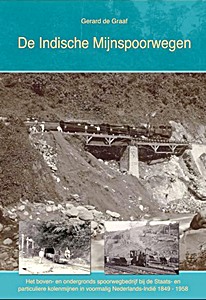
De Indische Mijnspoorwegen
The first passenger train in the Indonesian archipelago started operating on Java in 1867. However, as early as 1849, the Government implemented rail transport at the 'Oranje Nassau' coal mine in Pengaron on Southeast Borneo. Coal mining under the direction of Sultans had long existed in the Indonesian archipelago, but it did not involve rail transport.
After 1880, the number of European-style coal mines increased, but it was not until 1899 that the first steam locomotive reached the mining industry in the Dutch East Indies. Later, locomotives with internal combustion engines also appeared, powered either by electricity or compressed air.
Several thousand mine wagons came from Europe to the Dutch East Indies. Hardly anything was manufactured in the then colony itself. Some mines also had passenger transport, but only for their own personnel. The economic crisis of 1929 caused a devastating decline among the mines in the East Indies, but a few new ones were added during the Japanese occupation.
Of the coal mines and mining railways described in this book during the period 1849-1958, there is only one coal mine of Dutch origin remaining in present-day Indonesia that not only still exists but also still transports coal by rail.
Gerard de Graaf spent over 20 years on archival research and also visited virtually all mining sites on Java, Sumatra, Borneo, and Sulawesi to see what could still be found of the past.
Dettagli del libro
| Autore: | Gerard de Graaf |
|---|---|
| Formato: | 196 pagine, 30.5 x 22 x 1.7 cm, copertina rigida |
| Illustrazioni: | riccamente illustrato |
| Lingua: | olandese |
| Editore: | Uitgeverij de Alk B.V. (NL, 2020) |
| ISBN: | 9789059612327 |