Acquistando tramite i link, sostieni nostro sito senza alcun costo aggiuntivo per te. Per saperne di più >

Veicoli militari - Austria: libri - storia e modelli

Un libro sui veicoli militari austriaci? Scoprite qui i volumi illustrati sulla storia, i modelli e la tecnologia dei veicoli militari.

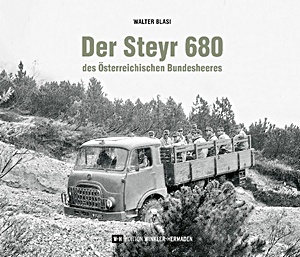
Der Steyr 680 des Österreichischen Bundesheeres

The Steyr 680 became the main transport vehicle of the Austrian Armed Forces from the late 1960s. It was used mainly for carrying supplies and troops, offering space for a driver, co-driver, and up to 18 soldiers.
Based on civilian models, the military version was adapted to army needs and replaced the less powerful Steyr 580 g.

Two versions were produced: a two-axle and a three-axle truck. The initial two-axle model proved insufficient compared with the American GMC, leading to the introduction of a three-axle version.
In nearly 40 years of service, the Steyr 680 became, alongside the Haflinger and Pinzgauer, one of Austria's most iconic military vehicles, familiar to generations of soldiers.

Dettagli del libro

Autore:Walter Blasi
Formato:116 pagine, 20 x 23.5 x 1.4 cm, copertina rigida
Illustrazioni:135 foto in B&N e in colori
Lingua:tedesco
Editore:Edition Winkler-Hermaden (A, 2024)
ISBN:9783951976242
Copertina del libro: Der Steyr 680 des Österreichischen Bundesheeres | Edition Winkler-Hermaden

Der Steyr 680 des Österreichischen Bundesheeres

Lingua: tedesco

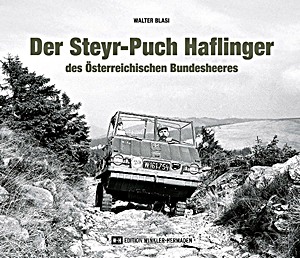
Der Steyr-Puch Haflinger des Österreichischen Bundesheeres

The Steyr-Puch Haflinger is now a cult vehicle. Its museum home is the Puch Museum in Graz, where many variants are displayed. It can still be seen on the road, and thanks to the internet, there is a global community of Haflinger fans.

Walter Blasi describes in his book the long journey of this vehicle to becoming a key pillar of the Austrian Armed Forces. The groundwork for the Haflinger was laid in 1956, and the first prototypes were built in 1957.
The test drives by the Graz testing department attracted great public interest. In 1959, the vehicle went into series production as the "Haflinger Type 700 AP".
The name "Haflinger" comes from a well-proven mountain horse of the armed forces and was spontaneously coined during a demonstration. From 1958, the vehicle was tested in several military units.
The Haflinger was used for commanders, command posts, and small radio teams. The standard version was four-seater, the radio Haflinger three-seater.
The vehicle became a military export hit. 80 percent of the production was exported to 110 countries. In the 1970s, many vehicles were exported to Africa. The decline in demand was gradually offset by orders for its larger brother, the Pinzgauer.

Dettagli del libro

Autore:Walter Blasi
Formato:116 pagine, 20.5 x 24 x 1.5 cm, copertina rigida
Illustrazioni:riccamente illustrato con foto in B&N e in colori
Lingua:tedesco
Editore:Edition Winkler-Hermaden (A, 2020)
ISBN:9783950472097
Copertina del libro: Der Steyr-Puch Haflinger des Österreichischen Bundesheeres | Edition Winkler-Hermaden

Der Steyr-Puch Haflinger des Österreichischen Bundesheeres

Lingua: tedesco

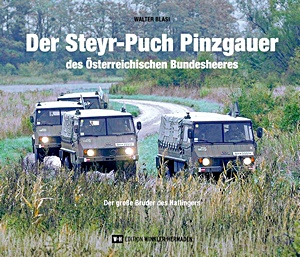
Der Steyr-Puch Pinzgauer des Österreichischen Bundesheeres

After his book on the Haflinger, Walter Blasi now presents a richly illustrated documentation of its successor, the Steyr-Puch Pinzgauer of the Austrian Armed Forces. The Pinzgauer, considered one of the world's best off-road vehicles, gained international acclaim and cult status.
Demand for a larger, more powerful vehicle led to series production in 1964. Prototypes had already been tested in 1965.

Two main versions were built: 4×4 and 6×6, adapted to different tasks. Initially fitted with a petrol engine, the model was later equipped with a diesel engine.
Several thousand vehicles were supplied to the Austrian and Swiss armies. After nearly 30 years of production and about 24.000 units, manufacturing ceased in Graz in 2000.

Dettagli del libro

Autore:Walter Blasi
Formato:120 pagine, 21.5 x 24 x 1.5 cm, copertina rigida
Illustrazioni:riccamente illustrato
Lingua:tedesco
Editore:Edition Winkler-Hermaden (A, 2022)
ISBN:9783950493764
Copertina del libro: Der Steyr-Puch Pinzgauer des Österreichischen Bundesheeres | Edition Winkler-Hermaden

Der Steyr-Puch Pinzgauer des Österreichischen Bundesheeres

Lingua: tedesco

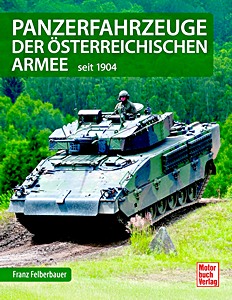
Panzerfahrzeuge der österreichischen Armee - seit 1904

NUOVO

Austria's armed forces possess a remarkable range of armored vehicles. The first models were built by Austro-Daimler between 1903 and 1905. In the 1930s, the army used various Italian tankettes.
After World War II, modern armored units were formed, initially equipped with American and French vehicles such as the AMX-13. Later, domestic designs like the Kürassier tank destroyer were introduced. Today, the German Leopard 2A4 serves as the Austrian Army's main battle tank.

In this richly illustrated book, military historian Franz Felberbauer presents a complete overview of Austria's armored vehicles - from Steyr ADGZ, Kürassier and Ulan to Pandur, Dingo, and Leopard 2A4.
The book includes technical data, historical context, and rare photographs. The author also contributed to the technical development of several vehicles himself.

Dettagli del libro

Autore:Franz Felberbauer
Formato:128 pagine, 28.5 x 21 x 1.3 cm, copertina rigida
Illustrazioni:140 foto in B&N e in colori
Lingua:tedesco
Editore:Motorbuch Verlag (D, 2025)
ISBN:9783613047631
Copertina del libro: Panzerfahrzeuge der österreichischen Armee - seit 1904 | Motorbuch

Panzerfahrzeuge der österreichischen Armee - seit 1904

Lingua: tedesco

Titoli correlati:

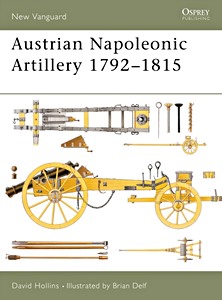
Copertina del libro: Austrian Napoleonic Artillery 1792–1815 | New Vanguard (72)

Austrian Napoleonic Artillery 1792–1815

David Hollins | inglese | brossura | 48 p. | 2003

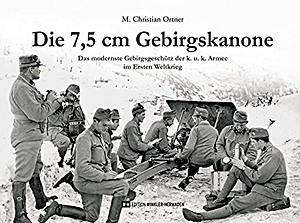
Copertina del libro: Die 7,5 cm Gebirgskanone - Das modernste Gebirgsgeschütz der k. u. k. Armee im Ersten Weltkrieg

Die 7,5 cm Gebirgskanone - Das modernste Gebirgsgeschütz der k. u. k. Armee im Ersten Weltkrieg

M. Christian Ortner | tedesco | copertina rigida | 96 p. | 2019